

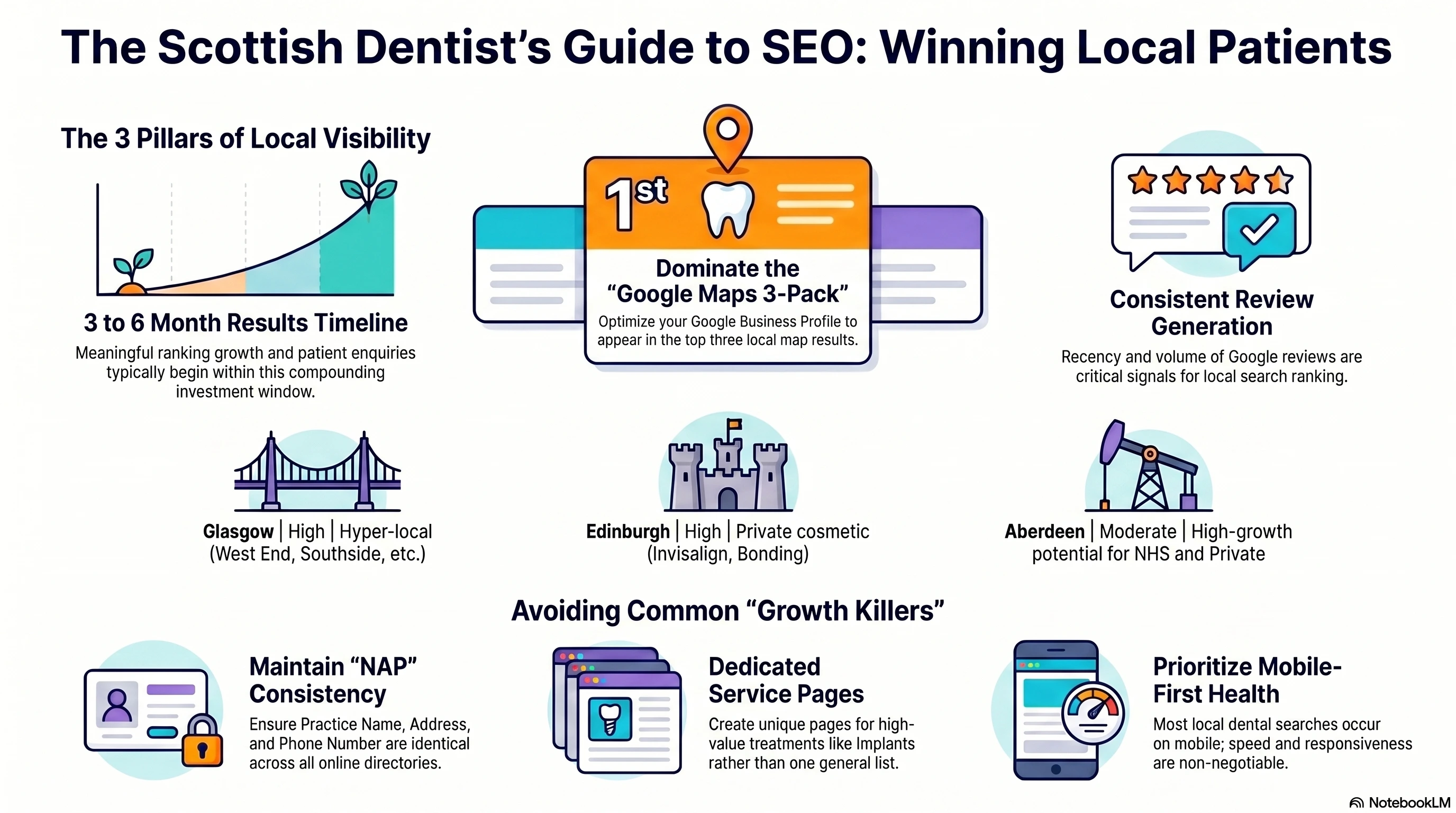
If you run a dental practice in Scotland and are not appearing at the top of Google when patients search for a dentist nearby, you are likely losing new patient enquiries every single day. Dental SEO in Scotland is the process of optimising your website and online presence so that your practice ranks highly in local search results, appears in the Google Maps 3-pack, and attracts a steady flow of new patients without depending solely on paid advertising.
At Qaushik, we provide SEO services designed specifically for local and healthcare businesses across Scotland. Our SEO services in Scotland cover everything from Google Business Profile optimisation to on-page content, technical SEO, and local citation building. Whether your dental practice is based in Glasgow, Edinburgh, or Aberdeen, we can build an SEO strategy that brings the right patients to your website at the moment they are actively looking for dental care.
This guide covers what dental SEO involves, why it is important for practices in Scotland, and how a properly structured SEO campaign can help your practice grow through organic search.
When someone in Glasgow, Edinburgh, Aberdeen, Dundee, or Inverness needs a dentist, their first action is almost always a Google search. They might search for terms like "dentist near me", "NHS dentist Glasgow", "teeth whitening Edinburgh", "dental implants Aberdeen", or "emergency dentist Dundee". If your practice is not appearing on the first page of these results, or inside the Google Maps 3-pack, your competitors are capturing those patients instead.
Dental SEO matters in Scotland because it directly affects how many new patients find your practice. Unlike Google Ads, which stop generating enquiries the moment you pause spend, well-executed SEO builds a long-term organic presence that continues to deliver results over time. Many dental practices across Scotland still rely on word-of-mouth and referrals alone, which means there is a significant opportunity for practices that invest in SEO to gain a strong advantage in local search rankings.
The dental market in Scotland is competitive, particularly in cities like Glasgow and Edinburgh where multiple practices compete for the same search terms. Practices offering private treatments such as Invisalign, composite bonding, dental implants, and teeth whitening face even stronger competition in search. A proper dental SEO strategy helps your practice appear ahead of competitors for both NHS and private dental search terms, making it easier for patients to find and choose you.
As explored in our guide on healthcare SEO in Scotland 2026, the way patients find health and dental services has shifted significantly toward online search, and practices that optimise their digital presence early are seeing measurable growth in new patient enquiries.
Dental SEO is the process of improving your dental practice website so that it ranks higher in search engine results when potential patients search for dental services in your area. It combines several disciplines including local SEO, on-page content optimisation, technical website improvements, Google Business Profile management, link building, and review management.
Google uses hundreds of ranking signals to decide which dental practices to show at the top of local search results. The most important signals for dental practices are relevance, proximity, and authority. Relevance means your website clearly communicates the dental services you offer. Proximity means Google understands where your practice is located relative to where the patient is searching. Authority means your website and online presence are trusted by Google through content quality, backlinks, and consistent business information across the web.
Dental SEO works by improving each of these signals in a structured and sustainable way. This may involve rewriting service pages to target the right keywords, fixing technical issues that prevent Google from properly reading your site, building local citations so your NAP (name, address, phone) data is consistent everywhere, and generating more patient reviews on Google so your profile appears more trustworthy.
The goal is not just to rank for generic terms like "dentist Scotland" but to rank for the specific, high-intent searches your ideal patients are making every day. Understanding how patients search is the foundation of any effective dental SEO strategy.
If you are new to the concept of search optimisation, our SEO beginners guide provides a clear overview of how the process works and why it matters for local businesses.
Local SEO is the most important type of SEO for dental practices because almost all dental searches are location-based. Patients are not searching for a dentist in a different city. They are searching for a dentist near their home, their workplace, or their children's school. This means your local SEO must clearly signal to Google exactly where you are located and which areas you serve.
Local SEO for dental practices in Scotland involves several key activities:
NAP Consistency
Your practice name, address, and phone number must be identical across every platform where your business appears. This includes your website, Google Business Profile, NHS Choices listing, Yell, Thomson Local, Yelp, and any other directory. Inconsistencies in your NAP data confuse Google and weaken your local rankings.
Location-Specific Service Pages
If your dental practice offers a range of services, each major service should have its own dedicated page with location-specific content. For example, a page targeting "dental implants Glasgow" will perform far better than a single general services page trying to rank for multiple treatments across multiple cities.
Local Citations and Directory Listings
Building consistent citations across reputable UK and Scotland-specific directories strengthens your local authority. This tells Google that your business is real, established, and operating at the location you claim. Citations are a foundational part of local SEO that many dental practices in Scotland overlook.
Schema Markup for Dental Practices
Structured data markup helps Google understand your business information more clearly. Adding LocalBusiness and Dentist schema to your website gives Google clean, structured signals about your practice type, location, opening hours, and services.
Our guide on local SEO for healthcare in Scotland covers how healthcare and dental businesses can build a stronger local presence through structured optimisation.
Your Google Business Profile is one of the most powerful tools you have for attracting local patients. When someone searches for a dentist in Glasgow, Edinburgh, or Aberdeen, the Google Maps 3-pack is often the first result they see before any organic website listings. If your practice is not appearing in that 3-pack, you are missing a significant portion of local search traffic.
Optimising your Google Business Profile for a dental practice involves more than simply claiming the listing and adding your address. A properly optimised profile includes:
- accurate and complete business information including name, address, phone number, and website
- the correct primary and secondary business categories
- a detailed and keyword-rich business description
- a full list of dental services listed within the profile
- regularly updated photos of the practice, treatment rooms, and team
- consistent opening hours and special hours for holidays
- active review management and response to patient reviews
- regular Google posts about offers, treatments, and practice news
- Q&A section actively managed with useful answers
Many dental practices in Scotland have unclaimed or poorly maintained Google Business Profiles, which means their competitors with well-optimised profiles are appearing ahead of them in local map searches. Fixing this alone can produce a noticeable improvement in local visibility within a few weeks.
Understanding how Google Business Profile works and how it interacts with your website and reviews is essential. Our overview on what is Google Business Profile explains the fundamentals in detail.
On-page SEO refers to the optimisations made directly on your dental website to help search engines understand what each page is about and to help patients find the information they need. For dental practices in Scotland, on-page SEO is often where the biggest ranking improvements can be made because many dental websites are either too thin in content, missing key service pages, or using the wrong keyword targeting.
Title Tags and Meta Descriptions
Every page on your dental website should have a unique title tag that includes the primary keyword and your location. For example, a title tag like "Teeth Whitening Glasgow | Dental Practice Name" signals clearly to Google what the page is about and where the service is offered. Meta descriptions do not directly affect rankings but influence click-through rates in search results.
Service Pages
Each major dental treatment you offer should have its own dedicated service page. Treatments such as dental implants, Invisalign, composite bonding, teeth whitening, dental veneers, root canal treatment, and emergency dental care each represent a distinct search intent. Having a well-written, location-specific page for each treatment significantly improves your chances of ranking for those high-value search terms.
Header Structure and Keyword Usage
Pages should use a logical header structure with H1, H2, and H3 tags that reflect the page topic and include relevant keywords naturally. Keyword stuffing is counterproductive and can harm rankings, but using relevant terms in a natural and informative way across headings, body content, image alt text, and internal links all contribute positively to how Google reads and ranks the page.
Internal Linking
Strong internal linking between your service pages, blog content, and location pages helps Google understand the structure of your site and distributes ranking authority across your pages. It also helps patients navigate to relevant information more easily, which improves time on site and reduces bounce rates.
Content is one of the most important long-term drivers of dental SEO performance. Beyond your core service pages, a consistent content strategy helps your dental website rank for a wider range of search terms, build authority in your specialty, and answer the questions patients are already asking before they book an appointment.
A good content strategy for a dental practice in Scotland might include:
- blog posts answering common patient questions such as "how much do dental implants cost in Scotland" or "is Invisalign available on the NHS"
- before and after treatment guides for cosmetic dental procedures
- local area pages targeting surrounding towns and neighbourhoods if you serve patients from a wider catchment
- FAQ pages addressing common concerns about dental procedures, costs, recovery, and aftercare
- patient education content about oral health, gum disease, teeth grinding, and preventive care
- news and practice updates that keep the website fresh and regularly updated
Each piece of content should be built around real search queries, written clearly for patients rather than for other dentists, and structured in a way that is easy for both Google and readers to navigate. Thin, generic content that does not add value performs poorly and can actually drag down the overall authority of your website.
Content strategy also plays a growing role in how dental practices appear in AI-powered search tools and generative search experiences. Our guide on how to get your content cited by ChatGPT covers how well-structured content can help your practice appear in AI-generated answers, which is becoming an increasingly important visibility channel.
Patient reviews are a significant ranking factor for local dental SEO and a powerful trust signal for prospective patients. Dental practices with a high volume of positive, recent Google reviews consistently rank higher in the local 3-pack than practices with fewer or older reviews. Beyond rankings, reviews directly influence whether a patient chooses your practice over a competitor, even if both appear in the same search result.
For dental practices in Scotland, a review strategy should focus on:
- consistently asking happy patients to leave a Google review after their appointment
- making the review process as easy as possible by sending a direct review link via text or email
- responding professionally to every review, both positive and negative, to show engagement and care
- monitoring reviews across platforms including Google, NHS Choices, Trustpilot, and Facebook
- using review insights to identify service areas that patients frequently praise or raise concerns about
A dental practice that collects ten new reviews per month will, over six months, build a significantly stronger local profile than a competitor that collects one or two reviews in the same period. Volume, recency, and response rate all contribute to how Google evaluates your review profile. This connects closely with the principles covered in our post on Google review automation in Scotland, which explores how practices can systematise their review collection process.
Technical SEO refers to the backend health of your dental website and how well it is structured for search engine crawling and indexing. Many dental websites in Scotland were built several years ago and have accumulated technical issues that quietly suppress rankings without the practice being aware.
Key technical SEO areas to address for a dental website include:
Page Speed and Core Web Vitals
Google uses page speed as a ranking factor, and patients are also less likely to stay on a slow-loading dental website. Images should be properly compressed, code should be clean, and the hosting environment should be reliable. Core Web Vitals scores, which measure loading performance, interactivity, and visual stability, should meet Google's recommended thresholds.
Mobile Responsiveness
The majority of local dental searches in Scotland happen on mobile devices. If your dental website is not fully responsive and easy to navigate on a smartphone, both your rankings and your patient conversion rate will suffer. Google uses mobile-first indexing, which means the mobile version of your site is the primary version Google evaluates.
HTTPS Security
All dental websites should use HTTPS. Google treats secure websites as a ranking signal and patients expect to see the padlock icon, particularly when submitting personal or medical enquiry information through a contact form.
Crawlability and Indexing
Google must be able to crawl and index every important page on your website. Common issues include pages accidentally blocked by robots.txt, duplicate content, broken links, and missing or duplicated title tags and meta descriptions. A technical SEO audit will surface these issues and prioritise them for resolution.
If you have not had your dental website reviewed recently, our website audit service in Glasgow 2026 covers how a structured audit identifies the technical gaps that are most likely holding your rankings back.
While many dental SEO principles apply across the board, the competitive landscape and search behaviour varies by city. Here is how dental SEO applies across Scotland's main cities.
Dental SEO Glasgow
Glasgow is Scotland's largest city and has one of the most competitive dental search landscapes. There are hundreds of dental practices competing for visibility across Glasgow's many neighbourhoods. Dental SEO in Glasgow must focus on hyper-local optimisation, targeting specific areas such as the West End, Southside, East End, and city centre rather than simply trying to rank for "dentist Glasgow" as a broad term. Practices offering private cosmetic treatments face particularly strong competition in Glasgow, making content quality and review volume especially important. Our broader SEO services in Glasgow support dental and healthcare businesses with localised strategies.
Dental SEO Edinburgh
Edinburgh's dental market is driven significantly by demand for private cosmetic dentistry alongside NHS provision. Patients searching for Invisalign, composite bonding, and teeth whitening in Edinburgh represent high-value leads. Dental SEO in Edinburgh should prioritise landing pages for premium treatments alongside strong local map visibility. Our SEO services in Edinburgh help dental practices in the capital compete effectively in both general and cosmetic dental search categories.
Dental SEO Aberdeen
Aberdeen has a strong demand for both NHS and private dental services, with a population that is increasingly searching online before choosing a practice. Dental SEO in Aberdeen can be highly effective because the market is less saturated than Glasgow or Edinburgh, meaning well-optimised practices can achieve strong rankings more quickly. Our SEO services in Aberdeen can help dental practices build a dominant local presence in a market where the competition is still catchable.
Dental SEO Dundee, Inverness, Stirling, and Perth
In smaller Scottish cities and towns, dental SEO can produce strong results relatively quickly because fewer practices are actively investing in digital marketing. Ranking for local dental searches in Dundee, Inverness, Stirling, or Perth is achievable within a reasonable timeframe with the right on-page optimisation, Google Business Profile work, and review strategy in place.
Many dental practices in Scotland invest in a website but make mistakes that prevent it from ranking well in search. Understanding these common errors helps you avoid them and build a stronger SEO foundation.
- No dedicated service pages: Having all treatments listed on a single page with minimal content means your website cannot rank for individual treatment searches. Each service needs its own page.
- Ignoring the Google Business Profile: A poorly maintained or incomplete Google Business Profile is one of the most common reasons dental practices do not appear in the local 3-pack.
- Not collecting reviews consistently: Sporadic review collection results in an outdated review profile. Google favours practices with a steady flow of recent, positive reviews.
- Slow and non-mobile-friendly websites: Many older dental websites load slowly on mobile and perform poorly on Core Web Vitals, which directly suppresses rankings.
- Duplicate content: Some dental practice websites use template content supplied by web design agencies, meaning multiple practices have near-identical pages. This is a significant SEO issue that prevents differentiation in search.
- No blog or content strategy: Practices that publish no new content give Google no reason to revisit their site frequently, and miss the opportunity to rank for the informational searches patients make before booking.
- Inconsistent NAP data: If your practice name, address, or phone number appears differently across different directories and platforms, Google struggles to build a confident picture of your business.
These mistakes are explored further in our guide on how long SEO takes to show results, which also explains how fixing foundational issues is often the fastest path to ranking improvement.
Dental SEO is not an overnight process, and any service promising rapid first-page rankings should be treated with scepticism. That said, many dental practices in Scotland begin to see meaningful movement in rankings and an increase in organic enquiries within three to six months of starting a properly structured SEO campaign.
The timeline depends on several factors:
- how competitive the local dental market is in your city
- the current technical health of your website
- how well your Google Business Profile is optimised
- the volume and quality of your existing Google reviews
- how much content your website currently has
- whether your competitors are actively investing in SEO
In a less competitive market like Inverness or Perth, a dental practice with a well-structured website and an optimised Google Business Profile may see local 3-pack improvements within six to eight weeks. In highly competitive markets like Glasgow city centre, building a strong enough presence to consistently rank in the top three positions may take six to twelve months of consistent work.
SEO should be viewed as an investment that compounds over time. Unlike paid advertising, rankings built through genuine SEO work continue to generate enquiries long after the initial work is done. The longer you wait to start, the longer it takes to catch up with competitors who have already been building their online presence.
We understand that dental practices in Scotland need an SEO partner who understands both local search and the healthcare environment. Our approach to dental SEO is practical, transparent, and built around the goal that matters most to you: more patients booking appointments at your practice.
When you work with us on dental SEO in Scotland, we can help you with:
- a full audit of your current website and Google Business Profile performance
- keyword research based on how patients in your area actually search
- on-page optimisation of existing service pages and creation of new ones where needed
- Google Business Profile setup and ongoing optimisation
- local citation building and NAP consistency across key directories
- review generation strategy to build a stronger patient review profile
- technical SEO fixes to improve crawlability, page speed, and mobile performance
- content creation targeting the questions and treatments your ideal patients are searching for
- monthly reporting showing ranking progress, traffic growth, and enquiry trends
Whether you are a single-location NHS and private practice in Aberdeen, a multi-site cosmetic dental group in Edinburgh, or a family dentistry practice in Glasgow looking to grow your patient list, we can build a dental SEO strategy that is proportionate to your market, your goals, and your budget. The same tailored, location-focused approach benefits businesses investing in real estate advertising in Aberdeen, automotive advertising in Aberdeen, and educational institutes advertising in Aberdeen, where local visibility and customer acquisition are key priorities.
Our strategies are designed around the realities of each market, ensuring that businesses operating in sectors such as healthcare advertising in Aberdeen and construction advertising in Aberdeen receive marketing solutions aligned with their specific goals, competition levels, and growth objectives.
Dental SEO in Scotland is not a one-size-fits-all service. It requires understanding your local competition, your patient profile, and the specific treatments you want to attract more enquiries for. If you are ready to grow your practice through organic search, our SEO services in Scotland are built to deliver exactly that.
Ready to Transform Your Digital Presence?
Let Qaushik Labs help you implement growth-focused solutions for your business. From websites and SEO to ads and automation, we’re here to help you generate better leads and revenue.
Get Started TodayThe cost of dental SEO in Scotland varies depending on the size of your practice, the competitiveness of your local market, and the scope of work required. We offer bespoke dental SEO packages tailored to your goals and budget. Contact us for a specific quote.
Most dental practices in Scotland begin to see meaningful ranking improvements and increased organic enquiries within three to six months of starting a structured SEO campaign. Timelines vary depending on how competitive your local market is and the current state of your website.
Yes. We provide localised dental SEO strategies for practices in Glasgow, Edinburgh, Aberdeen, Dundee, Inverness, Stirling, Perth, and across Scotland. Each city strategy is tailored to the specific competitive landscape and patient search behaviour in that area.
Yes. Google Business Profile optimisation is a core part of our dental SEO service. We set up, audit, and optimise your profile to improve your visibility in the Google Maps local 3-pack, which is where many patients find dental practices.
Dental SEO uses the same core principles as general SEO but applies them specifically to the dental industry. This means targeting treatment-specific keywords, optimising for local patient searches, managing healthcare-specific trust signals like reviews and NHS listings, and building content around the questions dental patients ask before booking.
Yes. SEO can be highly effective for attracting private dental patients searching for treatments like Invisalign, dental implants, composite bonding, teeth whitening, and veneers. Creating dedicated, well-optimised landing pages for each private treatment significantly improves your visibility for these high-value searches.