

Here's a hard truth: buyers don't care about your ego.
They don't want to see only the properties you have listed. They want to see everything available in their target area, price range, and criteria.
If your website only shows your personal listings, visitors assume you have limited inventory and bounce over to Zillow or Realtor.com — sites that show every listing.
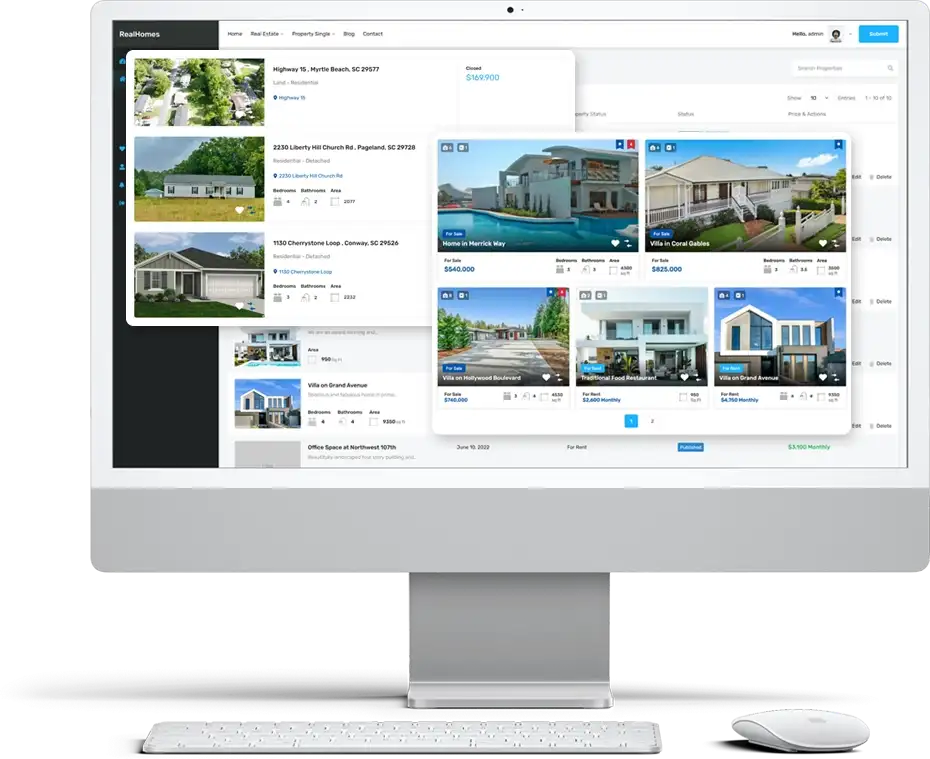
But what if your website could display every active listing in your MLS — automatically updated in real-time?
That's exactly what IDX integration does.
It transforms your site from a static brochure into a comprehensive property search portal that keeps buyers engaged and positions you as the go-to local expert.
Agents investing in professional real estate website development see far higher engagement once IDX search is added.
According to the National Association of Realtors, over 95% of buyers begin their journey online — and expect full inventory visibility.
Let's break down what IDX is, how it works, and why it's non-negotiable for serious agents in 2026.
IDX stands for Internet Data Exchange.
In plain English? It's a system that lets you legally display MLS listings from other agents on your own website.
The simple version:
- Your local MLS (Multiple Listing Service) contains all active property listings
- IDX is the technology that feeds those listings to your website
- Listings update automatically — no manual work required
- Visitors can search, filter, and browse just like on Zillow
- When they find something they like, they contact you
Think of it this way: Your website becomes a mini-Zillow, except you capture the leads instead of Zillow keeping them.
IDX doesn't just show your listings — it shows everything. All properties from all agents in your MLS, updated in real-time as listings go active, pending, or sold.
This instantly makes your site more valuable than 99% of agent websites out there. The same principle of providing comprehensive, up-to-date information can benefit businesses investing in healthcare advertising in Glasgow, construction advertising in Glasgow, home services advertising in Glasgow, and travel advertising in Glasgow, where users increasingly expect accurate and timely information before making decisions.
For businesses focused on plumbing advertising in Edinburgh and real estate advertising in Edinburgh, creating a website that delivers useful, current, and easily accessible information can improve user engagement, build trust, and support stronger lead generation outcomes.
This instantly makes your site more valuable than 99% of agent websites out there.
When IDX is implemented through a custom real estate website in Gurgaon, agents control both branding and lead flow.
Google also confirms that regularly updated, crawlable pages improve long-term visibility (Search Central).
People often confuse these terms, so let's clarify:
| Aspect | MLS | IDX |
|---|---|---|
| What it is | Database of property listings | Technology that displays MLS data on websites |
| Who uses it | Real estate professionals only | Agents who want to show listings publicly |
| Access | Requires agent license/membership | Requires MLS membership + IDX agreement |
| Updates | Agents manually add/update listings | Automatic sync from MLS (usually every 15 min) |
| Purpose | Professional tool for agents | Consumer-facing property search |
Bottom line: MLS is the source. IDX is the delivery system that gets MLS data onto your website for public viewing.
You can't have IDX without MLS access, but having MLS access doesn't automatically give you IDX capability on your site.
Pairing IDX with local SEO for real estate websites ensures these listings actually rank in Google instead of staying invisible.
Still wondering if IDX is worth it? Consider this:
Credibility Boost
Displaying thousands of listings positions you as a comprehensive market resource, not just someone hawking their own properties.
Keep Visitors on YOUR Site
Without IDX, buyers search on Zillow, then contact whatever agent is shown. With IDX, they search on your site and contact you.
SEO Goldmine
IDX creates thousands of indexable pages — similar to how scalable platforms are built in enterprise-level web systems.
Mobile-First Reality
Most buyers browse on phones, which is why mobile-optimized website architecture is critical for IDX success.
HubSpot research confirms that interactive content such as live listings significantly improves conversion rates (source).
Not all IDX solutions are created equal.
Agents who understand core SEO fundamentals consistently extract more long-term value from IDX-generated pages.
Dozens of IDX providers exist. Here's how to pick the right one:
MLS Compatibility
Does the provider support your local MLS? Some providers only work with certain MLSs. Verify compatibility first.
Customization Options
Can you match colors, fonts, and layout to your brand? Or are you stuck with cookie-cutter templates?
Mobile Performance
Test their demo on mobile. Is it fast? Easy to use? Does search work smoothly?
Lead Management
How are leads delivered? Email? Dashboard? CRM integration? Do you get instant notifications?
Support Quality
When something breaks (and it will), can you get help quickly? Check reviews about their support team.
Pricing Structure
Monthly fees typically range from $40-$150. Understand what's included and what costs extra.
Popular IDX Providers:
- IDX Broker — Industry leader, robust features, great support
- Showcase IDX — Beautiful designs, WordPress-friendly
- iHomefinder — Powerful search, excellent mobile experience
- Diversolutions (dsIDXpress) — Budget-friendly, solid basics
- Cloud CMA IDX — Good for teams, includes CMA tools
Pro tip: Ask to see live examples of agent sites using each platform before deciding.
Even with IDX, agents sabotage their own success. Don't make these errors:
Mistake #1: Hiding IDX Search
Burying property search on a submenu page. Put it front and center on your homepage.
Mistake #2: Generic IDX Pages
Using default templates that scream "generic IDX." Customize to match your brand.
Mistake #3: No Lead Capture Strategy
Showing listings but not requiring registration to see details. You're giving away value without getting contact info.
Mistake #4: Ignoring Mobile Users
If your IDX doesn't work perfectly on phones, you're losing 70% of potential leads.
Mistake #5: Not Promoting Saved Searches
Saved search alerts are passive lead generation machines. Prominently feature this option.
Mistake #6: Forgetting SEO Optimization
IDX creates thousands of pages. Without proper SEO settings, Google won't rank them.
Mistake #7: No Follow-Up System
Getting leads means nothing if you don't respond fast. Set up automated responses + immediate notifications.
Choosing an IDX provider shouldn't feel overwhelming.
We've created a comprehensive IDX Selection Checklist that covers everything you need to evaluate before making a decision.
What's included:
- Complete feature comparison worksheet
- MLS compatibility verification questions
- Pricing breakdown template
- Mobile optimization testing guide
- Lead capture capability checklist
- Support quality evaluation criteria
- Integration requirements for your CRM
- Contract terms to watch for
- 20+ questions to ask each provider
Plus bonus content:
- Top 5 IDX providers compared side-by-side
- Real agent reviews and experiences
- Setup timeline expectations
- Troubleshooting common IDX issues
This checklist has helped hundreds of agents avoid costly mistakes and choose the perfect IDX solution for their business.
Or if you want personalized guidance on IDX integration for your specific situation, schedule a free consultation with our real estate web specialists.
Let's recap why IDX integration is essential:
- Displays every active listing in your MLS automatically
- Positions you as a comprehensive market resource
- Captures leads for all properties, not just yours
- Updates in real-time with zero manual work
- Generates 3-5x more web leads than sites without IDX
- Keeps buyers on your site instead of Zillow
- Creates thousands of SEO-friendly pages for better rankings
Here's the bottom line: buyers expect comprehensive search. If you don't provide it, they'll go somewhere that does.
Zillow, Realtor.com, and Redfin aren't your competitors because they have better agents. They're winning because they show all the inventory.
IDX levels the playing field.
For $50-150/month, you can transform your website into a property search powerhouse that competes with the big portals — and keeps leads coming to you.
Ready to add IDX to your site?
Then, contact Qaushik Labs for expert IDX integration that's customized to your brand and optimized for maximum lead generation.
Don't let another day go by sending potential clients to Zillow. Take control of your web presence today.
Ready to Transform Your Digital Presence?
Let Qaushik Labs help you implement growth-focused solutions for your business. From websites and SEO to ads and automation, we’re here to help you generate better leads and revenue.
Get Started TodayIDX stands for Internet Data Exchange. It's a technology that allows real estate agents to display MLS (Multiple Listing Service) property listings from all agents on their own website. IDX automatically syncs listings every 15-30 minutes, keeping your site updated with the latest properties, price changes, and status updates without any manual work.
IDX integration typically costs between $40-$150 per month depending on the provider and features included. Setup fees may range from $0-$500. Popular providers like IDX Broker, Showcase IDX, and iHomefinder offer various pricing tiers. Additional costs may include custom design work ($500-$2,000) if you want the IDX pages fully branded to match your site.
No. IDX access requires active MLS membership in good standing. The IDX data feed comes directly from your MLS, so you must be a member with proper licensing. If you're not yet in the MLS, you'll need to join first before you can access IDX functionality for your website.
IDX (Internet Data Exchange) allows public display of MLS listings on your website. VOW (Virtual Office Website) requires user registration before showing certain listing details. IDX is more common for lead generation since it lets visitors browse freely. VOW is more restrictive but some MLSs require it. Check your local MLS rules to see which applies to you.
Quality IDX providers optimize for speed, but poorly implemented IDX can slow your site. Choose providers that use CDN delivery, image compression, and lazy loading. Test mobile load speeds before committing. At Qaushik Labs, we optimize IDX integration to maintain fast page speeds while displaying thousands of listings seamlessly.
Yes, but customization levels vary by provider. Basic IDX solutions offer limited styling options (colors, fonts). Premium solutions allow full design control to match your brand perfectly. Some require custom CSS knowledge; others provide visual editors. Always review customization capabilities before choosing an IDX provider, and ask to see customized examples from other agents.