

If your business is getting enquiries on WhatsApp but replies are inconsistent, follow-up is delayed, and too many conversations depend on one person manually handling everything, that is not just a communication issue. It is a sales and conversion issue.
Our WhatsApp Automation Service in Scotland is built for businesses that want WhatsApp to become a real operational and revenue-driving channel. We create structured WhatsApp systems using GoHighLevel workflows, GHL AI agents, conversation logic, CRM automation, and follow-up sequences so your business can respond faster, qualify leads better, reduce repetitive admin, and convert more enquiries into calls, bookings, appointments, and sales. This kind of setup is often part of a wider lead generation automation strategy in Scotland. HighLevel supports WhatsApp workflow integration, direct WhatsApp workflow actions, and Conversation AI setup inside sub-accounts, which makes it viable to build this kind of system natively within the platform.
This is not generic chatbot setup. It is a conversion-focused WhatsApp automation service in Scotland built inside GHL for businesses that want a practical, commercially useful system rather than a basic auto-reply, especially when combined with AI chatbot development in Scotland for stronger first-response handling.
Looking for WhatsApp Automation Service in Scotland That Actually Converts Enquiries?
A lot of businesses already use WhatsApp, but they do not use it systematically. What usually happens is predictable:
- a lead messages after hours and gets no reply
- the team answers late and the lead goes cold
- the same questions get repeated every day
- nobody qualifies the lead properly before handover
- reminders, confirmations, and updates are inconsistent
- follow-up depends on memory instead of automation
- promising leads stop replying and nobody re-engages them
That is exactly where our WhatsApp Automation Service in Scotland becomes useful. We design WhatsApp systems that move people toward a clear next step. That next step could be a consultation, appointment, sales call, property viewing, clinic visit, service enquiry, training callback, or support resolution. Meta positions the WhatsApp Business Platform as a business messaging solution for automated communication, customer support, and business-initiated messaging using approved templates after opt-in, which is why it is suited to structured sales and service workflows rather than just ad hoc messaging.
If your website also plays a role in lead generation, this service works especially well alongside our web development services, because the best results usually come when the landing page, form, CTA, and WhatsApp conversation all support the same conversion journey.
A WhatsApp Automation Service helps your business automate selected parts of customer communication on WhatsApp without removing human control where it matters. That can include:
- instant welcome replies
- lead qualification questions
- FAQ handling
- routing to the right team member
- reminder messages
- booking confirmations
- re-engagement of inactive leads
- support updates
- document or media delivery
- post-enquiry follow-up
- pipeline movement inside the CRM
On the platform side, Meta supports business-initiated template messages after opt-in, utility-style messages such as appointment reminders and updates, and richer message formats through the WhatsApp Business Platform. HighLevel, in turn, supports WhatsApp workflow integration and direct WhatsApp workflow actions, which allows us to create real automation sequences inside GHL rather than relying on disconnected tools.
In simple terms, this means your business can stop treating WhatsApp as a loose inbox and start using it as a structured customer journey, often supported by Go High Level automation in Scotland for better pipeline and workflow control.

That is exactly what we provide. We build WhatsApp automation systems in GoHighLevel using GHL workflows, conditional logic, triggers, CRM actions, and AI agent capability where suitable. HighLevel current documentation supports workflow-based WhatsApp messaging, WhatsApp workflow integration, and Conversation AI setup, which means these systems can be built as part of a larger automated lead-handling environment, including broader lead generation automation workflows in Scotland.
That can include:
- WhatsApp response workflows for new leads
- AI-guided first-response handling
- qualification flows before human handover
- appointment reminder workflows
- lead recovery automation
- customer support routing
- media delivery via workflow
- CRM updates based on message behaviour
HighLevel also documents media delivery through WhatsApp workflows, including images, video, audio, and documents, which can be useful where your sales process includes brochures, quotations, guides, checklists, or onboarding assets.
So when we say we create this using GHL AI agent and workflow, that is not vague positioning. It reflects a real implementation path based on what the platform currently supports.

For local businesses in Scotland, WhatsApp often sits very close to the point of conversion. People do not usually open WhatsApp unless they want one of a few things quickly:
- an answer
- a price
- a booking
- a callback
- a confirmation
- reassurance before taking the next step
That is why poor WhatsApp handling can lose revenue so easily. A strong automation setup helps by making the channel faster, clearer, and more reliable. Instead of leaving leads waiting, the system can acknowledge the enquiry immediately, collect useful information, answer common questions, deliver the right next step, and escalate high-intent cases to a human.
This is particularly useful for businesses in Scotland where local trust and fast response time matter, such as clinics, training academies, agencies, consultants, trades, legal services, and home improvement companies.
Want WhatsApp Automation in Scotland for Lead Generation, Follow-Up, and Customer Support?
A properly built WhatsApp automation system can support multiple commercial functions at once. It can also work naturally with appointment booking automation in Scotland where the goal is to move leads toward confirmed bookings more efficiently. It can help with:
- lead generation, by capturing and qualifying inbound enquiries faster
- sales follow-up, by re-engaging leads that did not act the first time
- appointment handling, by sending reminders and confirmations
- customer support, by answering repetitive queries and routing issues
- operations, by reducing manual effort and keeping response quality consistent
Meta explicitly distinguishes messaging use cases and categories such as utility communication and business-initiated template messaging, while HighLevel supports workflow-driven execution on the CRM side. That combination is why WhatsApp can be built into a broader sales and service automation system rather than remaining just a chat channel.
WhatsApp Funnel and Process Audit
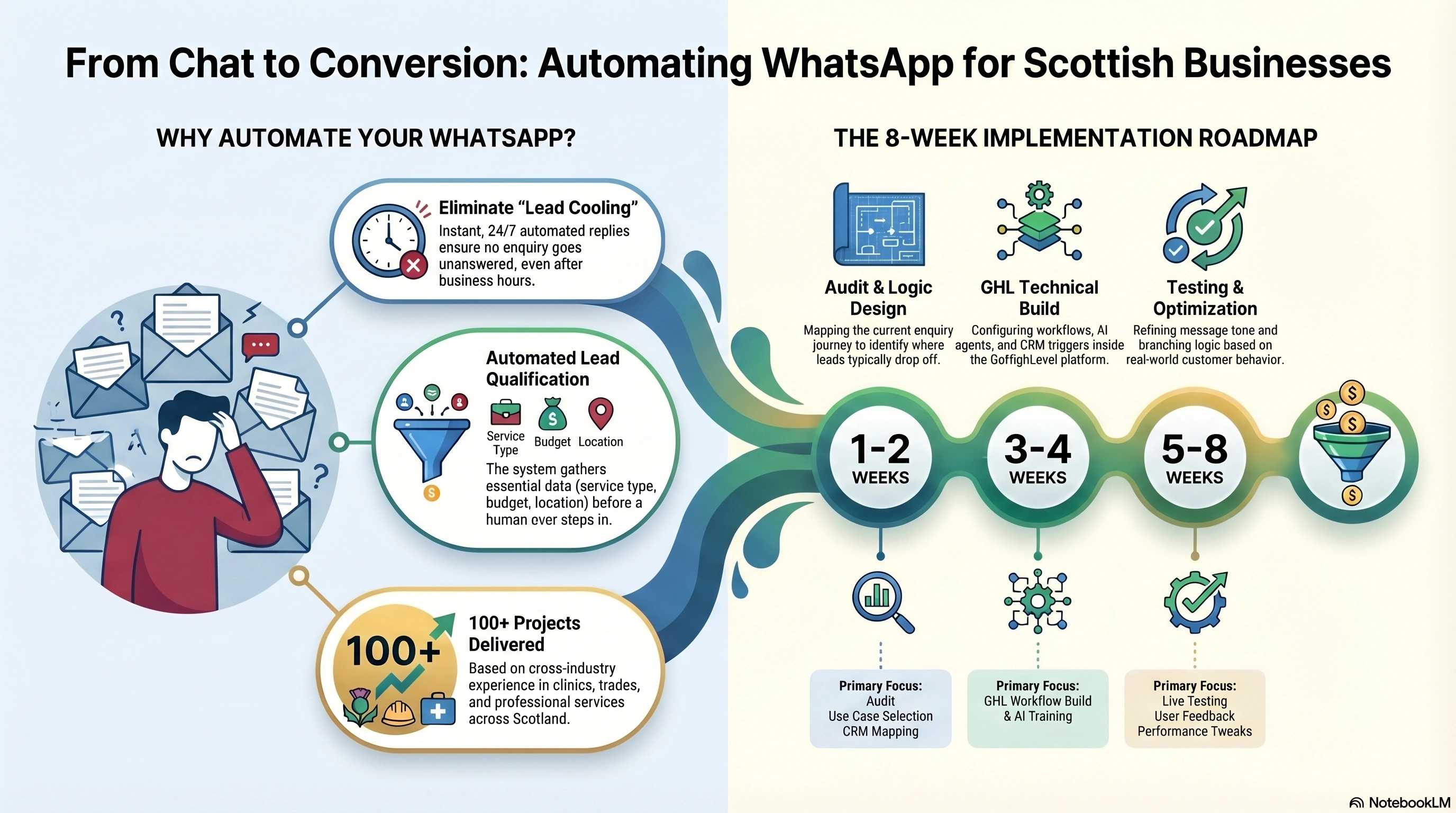
We start by understanding how your business currently receives and handles messages. We look at where WhatsApp sits in the customer journey, what types of enquiries come in, where delays happen, and which questions are repeated most often. The point is to identify exactly where automation improves conversion instead of adding unnecessary complexity.
GHL WhatsApp Workflow Setup
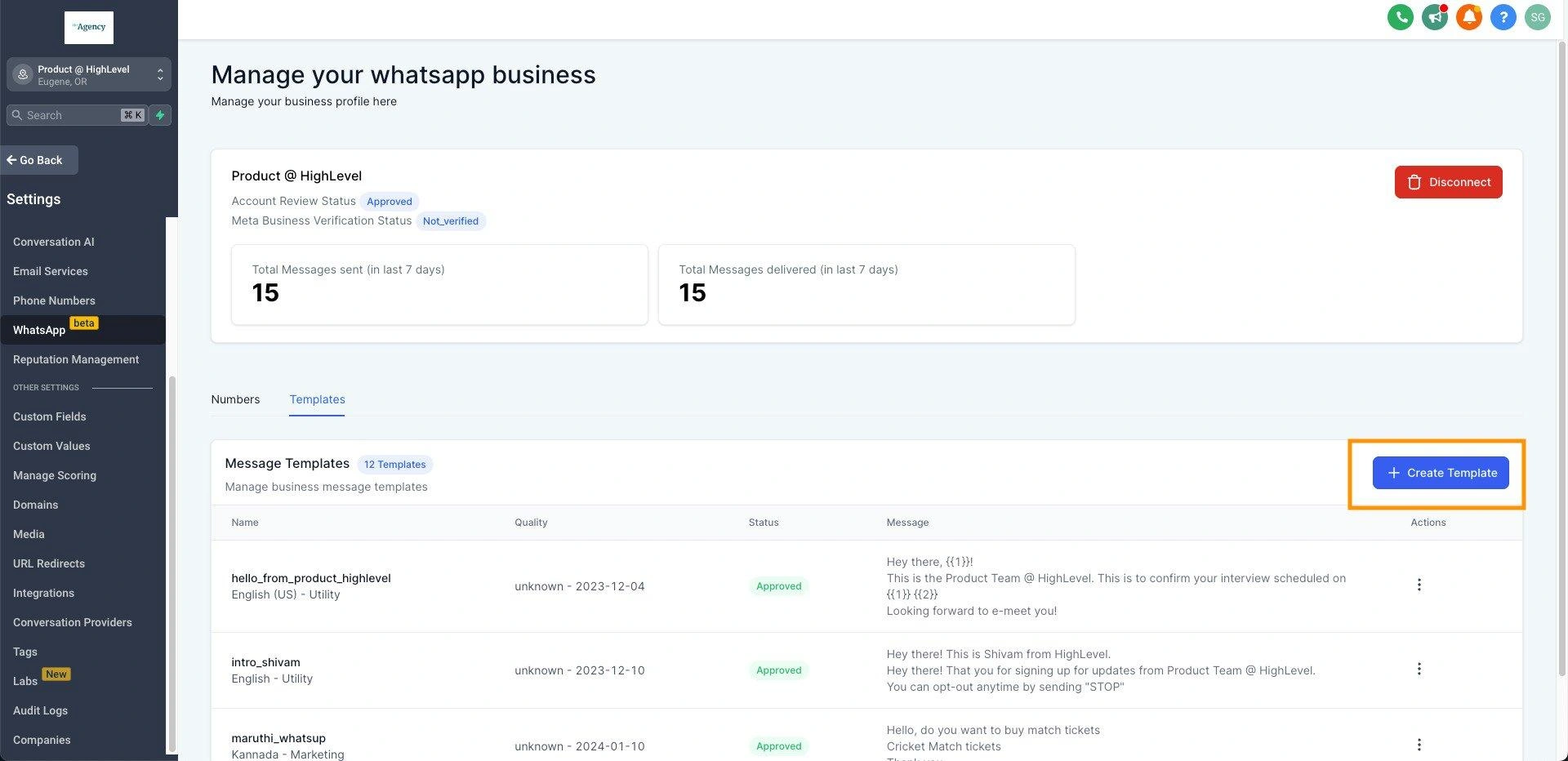
We build the automation logic inside GoHighLevel using workflows, triggers, and messaging actions. HighLevel's official documentation confirms that WhatsApp can be integrated into workflows and that a dedicated WhatsApp workflow action exists for sending direct WhatsApp messages, including template-based communication.
GHL AI Agent and Conversation Layer
Where suitable, we structure the first stage of the conversation using GHL AI agent / Conversation AI logic so the lead receives a fast, intelligent first touch rather than sitting unanswered. This approach overlaps well with AI chatbot development in Scotland where businesses want faster and more structured conversational handling. HighLevel currently documents Conversation AI setup for sub-accounts, which is the relevant product layer for this type of implementation.
Automated Welcome and Qualification Flow
We create a conversation path that can greet the lead, gather essential details, pre-qualify the enquiry, and move the person toward the correct next step. This reduces staff time spent on repetitive first-touch conversations.
Appointment Reminder and Confirmation Flows
If your business works on bookings or appointments, we can use WhatsApp for confirmation and reminder-type flows. This becomes even more effective when paired with appointment booking automation in Scotland so the full scheduling journey is handled more cleanly. Meta utility messaging documentation explicitly covers time-sensitive business messages such as updates and reminders, which is one of the strongest use cases for this channel.
Follow-Up and Lead Recovery
Not every lead converts immediately. We create structured follow-up logic so unresponsive or partially interested leads do not simply disappear.
Media, Document, and Information Delivery
Where your process requires brochures, offers, onboarding documents, instructions, or media, HighLevel supports WhatsApp media sending through workflows, which expands what the channel can do operationally.
CRM and Pipeline Movement
We can also align the WhatsApp automation with your CRM pipeline so that staff can see whether the lead is new, qualified, booked, inactive, followed up, or handed over. For businesses needing more custom backend control, this can also align with work from a Laravel development agency in Edinburgh.
Website and Landing Page Alignment
A strong WhatsApp system usually performs even better when it is connected with the wider digital journey. That is why many businesses pair this with our web development services and web development services in Scotland, especially where landing pages, click-to-WhatsApp buttons, forms, and thank-you flows need to support conversion together.
This service is especially useful for businesses where quick response and structured follow-up affect whether the lead converts. Common fit includes:
- clinics and healthcare providers
- beauty, wellness, and aesthetics businesses
- training institutes and academies
- agencies and consultants
- estate and property businesses
- home improvement and trade companies
- law firms and other professional services
- hospitality businesses
- multi-location service businesses across Scotland
If your business gets repeated enquiries, handles appointments, or loses leads because follow-up is inconsistent, WhatsApp automation can become one of the highest-leverage systems you put in place.
Yes, we can structure this service around city-focused demand as well as wider Scotland coverage. For businesses targeting specific city markets, the WhatsApp journey often performs better when the page, CTA, and message intent are locally aligned. That is why this service can be connected with supporting location-focused digital assets for Glasgow, Edinburgh, and Aberdeen.
This is particularly useful for service businesses where the user is often searching with local intent and wants a quick, direct way to enquire.
Step 1: We Review Your Current Enquiry Journey
Before building anything, we assess how enquiries currently move through your business. The purpose is not to add automation for the sake of it. The purpose is to identify exactly where leads slow down, get ignored, or drop out of the pipeline.
We look at questions such as:
- How quickly are new WhatsApp enquiries being answered?
- Are leads getting different responses from different team members?
- Are basic questions consuming too much staff time?
- Are leads being qualified before they reach sales or support?
- What happens after office hours?
- Are follow-ups happening consistently or only when someone remembers?
- Is the WhatsApp enquiry being tracked properly inside the CRM?
This audit stage is important because poor performance is often caused by process gaps, not just missing automation. In many businesses, the real issue is a combination of delayed replies, weak lead capture, no structured qualification, and no clear path from first message to booked call, appointment, or sale. That is why this stage often connects directly with lead generation automation planning in Scotland. By the end of this stage, we usually know where the friction sits and what the automation needs to fix first.
Step 2: We Define the Goal of the Automation
Not every business needs the same WhatsApp system. A clinic, a real estate business, a training academy, and a support-heavy service company all need different conversation logic. So before building workflows, we define the commercial objective. That may be:
- Faster first response to new enquiries
- Qualification of incoming leads before handover
- Routing leads to the right team or branch
- Reducing repetitive support questions
- Sending appointment confirmations and reminders
- Re-engaging cold leads
- Capturing key customer details automatically
- Keeping the conversation active after hours
- Using AI to handle the early part of the conversation before a human takes over
This stage matters because the workflow structure depends on the outcome you want. A system built for appointment reminders is very different from one built for lead qualification or city-based routing. Once the goal is clear, the automation becomes easier to design properly. Instead of creating a generic chat flow, we build a system around a defined business result.
Step 3: We Create the Workflow Logic in HighLevel
Once the use case is clear, we build the actual operational logic inside GoHighLevel. HighLevel supports WhatsApp workflow integration, dedicated WhatsApp workflow actions, customer service window checks, and Conversation AI configuration, which makes it viable for structured automation inside a commercial lead-handling system and broader Go High Level automation setups in Scotland.
This is where we design the flow using the core building blocks available in GHL, such as:
- Workflow triggers
- If/else branching
- Wait steps
- WhatsApp actions
- CRM pipeline movement
- Tagging and contact updates
- Internal notifications
- Assignment logic
- AI conversation behaviour
- Follow-up sequences
Depending on the business, the workflow may include logic such as:
New enquiry handling
When a user sends a new WhatsApp message, the system can trigger an instant acknowledgement, ask a few structured questions, and create or update the contact record in the CRM. GHL's WhatsApp actions are designed for sending messages directly from workflows, including manual messages and approved templates where required.
Lead qualification
The flow can ask relevant qualifying questions such as service type, city, urgency, budget, preferred date, or treatment interest. Based on the response, the contact can be tagged, routed, or moved into the right opportunity stage.
Routing and assignment
Leads can be routed by service type, location, language, or enquiry category. That means a customer asking about one service can go to one team, while another type of enquiry is assigned elsewhere.
Follow-up control
If the lead does not respond, the workflow can send timed reminders or move the enquiry into a longer nurture sequence. If the lead responds, the automation can stop the dormant follow-up path and move into an active conversation path.
Human handover
One of the most important parts of good automation is knowing when automation should stop. If a lead asks a complex question, requests a callback, or shows strong buying intent, the system should hand over cleanly to a human rather than forcing the person through robotic steps.
Customer service window logic
HighLevel also provides a WhatsApp customer service window check. This matters because WhatsApp has messaging rules around when free-form messages can be sent and when approved templates are required to initiate or continue contact. The customer service window lasts 24 hours after a user messages the business, and GHL provides workflow actions to check and branch around that. This part is operationally important because a workflow that ignores these messaging constraints can break the user experience or fail to send at the right stage.
Step 4: We Write the Messaging
Good automation is not only technical. It is also conversational. A poorly written WhatsApp flow can make the business sound slow, robotic, vague, or low quality. So the message writing stage is treated seriously.
We write the messaging around three principles:
1. Clarity
The user should immediately understand what is happening, what the business needs from them, and what the next step is.
2. Speed
WhatsApp is a fast medium. Long, clumsy paragraphs usually reduce response quality. The messages need to feel easy to read and easy to answer.
3. Commercial relevance
The conversation should help the lead move forward. Every message should either reduce confusion, collect useful information, create trust, or push the user closer to booking, buying, or speaking to the right person.
This means we usually write:
- Greeting messages
- Qualification questions
- Reassurance messages
- Office-hours or after-hours responses
- Appointment prompts
- Follow-up nudges
- Handover messaging
- Support redirection messages
- Re-engagement messages
Where AI is used, we also define the tone, the response boundaries, and the cases where AI should escalate instead of improvising. HighLevel's Conversation AI setup is specifically designed to configure this behaviour within the sub-account environment.
Step 5: We Test the User Experience
A workflow is not ready just because it technically runs. We test the system from the user side to see whether the conversation actually feels useful. This includes:
- How fast the first response arrives
- Whether the questions make sense in order
- Whether the replies are too long or too vague
- Whether the workflow branches correctly
- Whether tags, notes, pipeline movement, and assignments happen correctly
- Whether AI responses are relevant and controlled
- Whether a real user can actually reach the desired outcome without friction
This stage often reveals issues that are invisible from the backend, such as:
- Too many questions too early
- Poor message timing
- Confusing handover points
- Incorrect routing logic
- Broken fallback paths
- Bad message tone
- CRM stages not matching the actual conversation outcome
If templates, media, or interactive WhatsApp elements are part of the flow, these also need testing because GHL supports media delivery and interactive WhatsApp message types in workflows, but these only help when used in the right context.
Step 6: We Improve Based on Results
The first version is rarely the final version. Once the flow is live, we look at real conversation behaviour. That is where the most valuable optimisation happens. We review things such as:
- Which messages get replies and which get ignored
- Where users drop out
- Which objections appear repeatedly
- Which lead sources convert better
- Which questions cause friction
- Whether the AI is helping or slowing the journey
- Whether the routing logic is accurate
- Whether the workflow is improving booking rate, response time, or lead quality
Then we refine:
- Message wording
- Question sequence
- Wait times
- Routing conditions
- Follow-up timing
- Escalation rules
- AI instructions
- CRM stage movement
- Team notification logic
This is the difference between basic automation and commercially useful automation. A static workflow may function, but an optimised workflow performs better over time because it is based on live data and real customer behaviour.
Why This Process Matters
The main mistake businesses make is thinking WhatsApp automation is just about sending messages automatically. It is not. A good GHL WhatsApp system should do four things well:
- respond quickly
- move the user logically through the conversation
- capture commercially useful information
- hand over or convert the lead without friction
If the automation does not improve those outcomes, then it is only adding noise. A well-built system, by contrast, can reduce manual workload, improve first-response speed, keep enquiries active outside office hours, qualify leads more consistently, and make the CRM cleaner and more actionable.
The exact timeline depends on complexity, but a realistic implementation usually follows this structure.
Week 1: Audit and Strategy
In the first phase, we review the current enquiry journey and define the automation scope. This typically includes:
- Understanding how enquiries currently come in
- Reviewing response gaps
- Identifying business priorities
- Defining use cases
- Mapping conversation outcomes
- Deciding where AI should respond and where humans should take over
- Identifying CRM requirements, tags, assignments, and stages
This phase is strategic. It prevents poor build decisions later.
Week 2: Workflow and AI Conversation Design
In this stage, we create the actual logic model. This includes:
- Workflow mapping
- Trigger selection
- Branching logic
- Qualification path design
- Routing rules
- AI response scope
- Fallback behaviour
- After-hours handling
- Follow-up structure
- CRM movement design
By the end of this stage, the architecture should be clear before technical setup begins.
Week 3: Setup and Testing
This is the implementation stage inside GHL. We configure:
- WhatsApp actions
- Templates where required
- Contact update logic
- Tags and smart segmentation
- Opportunity stage movement
- Team notifications
- AI conversation settings
- Routing paths
- Wait timers and follow-up rules
- Customer service window checks where relevant
GHL's current WhatsApp documentation covers setup for sub-accounts, workflow actions, templates, and the customer-service-window handling needed for message compliance. Once built, we test the workflow manually across likely scenarios.
Weeks 4 to 8: Refinement and Optimisation
This is the optimisation window. Here we improve the automation based on real usage:
- real reply patterns
- real lead quality
- common objections
- drop-off points
- booking outcomes
- missed routing cases
- AI quality and containment
For some businesses, this phase creates the biggest performance lift because the real-world data makes it obvious what needs to be tightened.
What Affects the Setup Timeline
A simpler WhatsApp automation can launch relatively quickly. But the timeline increases when the project includes more complexity, such as:
- Multiple services
- Multiple branches or cities
- Multiple team handovers
- Separate flows for sales and support
- CRM pipeline complexity
- Appointment logic
- After-hours logic
- AI plus human hybrid handling
- Re-engagement workflows
- Reporting requirements
- Template approval dependencies
- WhatsApp compliance and conversation-window considerations
In practice, a basic setup may be relatively fast, while a more advanced system with several conversation types, multiple routing conditions, and deeper CRM integration usually needs a longer design and optimisation cycle.
The cost depends on the business model and the complexity of the system you need. Typical pricing factors include:
- number of flows to build
- complexity of the conversation logic
- whether GHL AI agent / Conversation AI is part of the setup
- qualification depth
- appointment or reminder use cases
- media or document delivery requirements
- CRM and workflow integration scope
- number of locations or teams
- ongoing optimisation and support needs
There is also a platform-level cost consideration. HighLevel's pricing guide references WhatsApp and AI as chargeable add-on areas within the broader billing ecosystem, while Meta separately maintains official WhatsApp Business Platform pricing and template/message category structures. So a realistic commercial setup should consider both implementation scope and underlying platform economics.
Some businesses only need a lean qualification and follow-up setup. Others need a broader WhatsApp automation engine that supports enquiry handling, reminders, routing, sales follow-up, and CRM visibility. The right structure depends on what will actually improve lead conversion.
Yes, but it needs to be done properly. Meta's developer documentation states that businesses must obtain opt-in before sending message templates to people on WhatsApp, and that opt-in should clearly explain the business and the reason for messaging.
From the UK side, the ICO explains that PECR applies to unsolicited direct marketing by electronic message, and that the rules are generally stricter for marketing to individuals. The ICO also says that direct messaging via social media can fall under electronic mail marketing rules.
That means a serious WhatsApp automation setup should account for:
- proper opt-in handling
- clear expectation setting
- separation between marketing and service-style messaging where relevant
- sensible follow-up frequency
- opt-out handling and privacy awareness
This matters not just for compliance, but for user trust. Over-automation without permission usually performs badly anyway.
Yes, and that is where it becomes especially valuable. Meta documents utility-style business messaging for time-sensitive updates and reminders, and the platform also supports business-initiated template messaging after opt-in. Combined with HighLevel's workflow execution layer, that makes WhatsApp useful for reminders, support-oriented communication, and structured follow-up when designed correctly.
That means your business can use WhatsApp for:
- appointment confirmations
- reminder sequences
- quote follow-up
- enquiry progression
- support updates
- customer onboarding steps
- lead reactivation
The real value comes from building the correct flow for your business rather than trying to make one generic sequence do everything. That is also why many businesses combine this with Google review automation in Scotland so post-service communication continues after the initial WhatsApp journey.
A well-built system can improve:
- response speed
- consistency of enquiry handling
- lead qualification quality
- follow-up completion
- customer convenience
- team efficiency
- appointment attendance support
- conversion from message to action
It can also reduce the operational chaos that happens when every WhatsApp conversation depends on manual effort, especially for businesses that need more structured systems similar to those built by a Laravel development agency in Edinburgh.
A bot that replies is not automatically useful. We focus on whether the system helps more enquiries turn into meaningful business actions. Every WhatsApp system we build is designed around a commercial outcome, not just the technical task of sending automated messages. If the automation does not help more leads convert, qualify, or move forward, it is not doing its job.
We do not position WhatsApp automation as a disconnected tool. We build it inside GoHighLevel using workflows, CRM logic, WhatsApp actions, and AI-led conversation handling where appropriate. This is one of the main strengths of our service. Building inside GHL means the WhatsApp system connects directly with your pipeline, your contacts, your tags, and your follow-up sequences, which creates a more scalable and controllable setup than using a separate chatbot tool with no CRM awareness, particularly when supported by Go High Level automation in Scotland.
The message flow has to make sense from the users point of view. We design for real-world intent, hesitation, and next-step behaviour, not just backend automation logic. A well-written, well-timed WhatsApp conversation feels helpful to the user, and that is what makes them more likely to respond, qualify, and take the next step, especially in journeys supported by AI chatbot development in Scotland.
This service also works naturally with our web development services and web development services in Scotland. The better your front-end and back-end work together, the stronger the results. A landing page, a click-to-WhatsApp button, and a well-structured conversation flow all need to support the same conversion journey. When they do, the results are noticeably better than when the WhatsApp system sits in isolation.
We can also structure the system around local intent and city-based service journeys, including digital support for Glasgow, Edinburgh, and Aberdeen. For businesses that serve specific cities or regions across Scotland, aligning the WhatsApp journey with the local page and CTA makes the overall system more relevant and more effective.
If your business is getting WhatsApp enquiries but too many conversations are unmanaged, delayed, repetitive, or commercially weak, the solution is not more manual effort. The solution is a better system. Our WhatsApp Automation Service Scotland helps businesses build a structured, conversion-focused WhatsApp setup using GoHighLevel AI agent capability, GHL workflows, CRM logic, and messaging automation so leads get faster responses, better guidance, and a clearer path to action. HighLevel's supported WhatsApp workflow features and Conversation AI setup make this a practical implementation route, while Meta's WhatsApp Business Platform provides the business messaging layer needed for structured customer communication.
If you also want the front-end journey to support the automation properly, this service can be aligned with our web development services, our web development services in Scotland, and city-specific implementation for Glasgow, Edinburgh, and Aberdeen.
Ready to Transform Your Digital Presence?
Let Qaushik Labs help you implement growth-focused solutions for your business. From websites and SEO to ads and automation, we’re here to help you generate better leads and revenue.
Get Started TodayYes. HighLevel officially supports WhatsApp workflow integration and direct WhatsApp workflow actions, which makes it possible to build structured automation inside the platform.
Yes. HighLevel currently documents Conversation AI setup, and that can be used where an AI-led first response or guided conversation layer makes sense for the business.
Yes. Meta supports utility-style messaging for time-sensitive communication such as reminders and updates, subject to the platform's rules and appropriate setup.
Yes. Meta states that businesses must obtain opt-in before sending message templates, and UK PECR rules may also apply depending on the nature of the messages.
Yes. It usually works better when the page journey and the WhatsApp conversation support each other, which is why this service often pairs well with our web development services.
Yes. We can structure the system for local businesses across Scotland, including city-focused setups for Glasgow, Edinburgh, and Aberdeen.