

SEO Portfolio Case Study:
Select Remodeling & Construction (The Woodlands, TX)
Local SEO + Performance Upgrade for High-Intent Remodel Searches
Select Remodeling & Construction is a remodeling contractor website focused on high-intent local searches—kitchen remodeling, bathroom renovations, home additions, custom cabinets, and more in and around The Woodlands, TX.
This project wasn’t just “add keywords.” It was a full SEO + performance upgrade where we improved crawl health, tightened on-page SEO across service + location pages, and fixed technical bottlenecks that were holding back rankings and conversions.
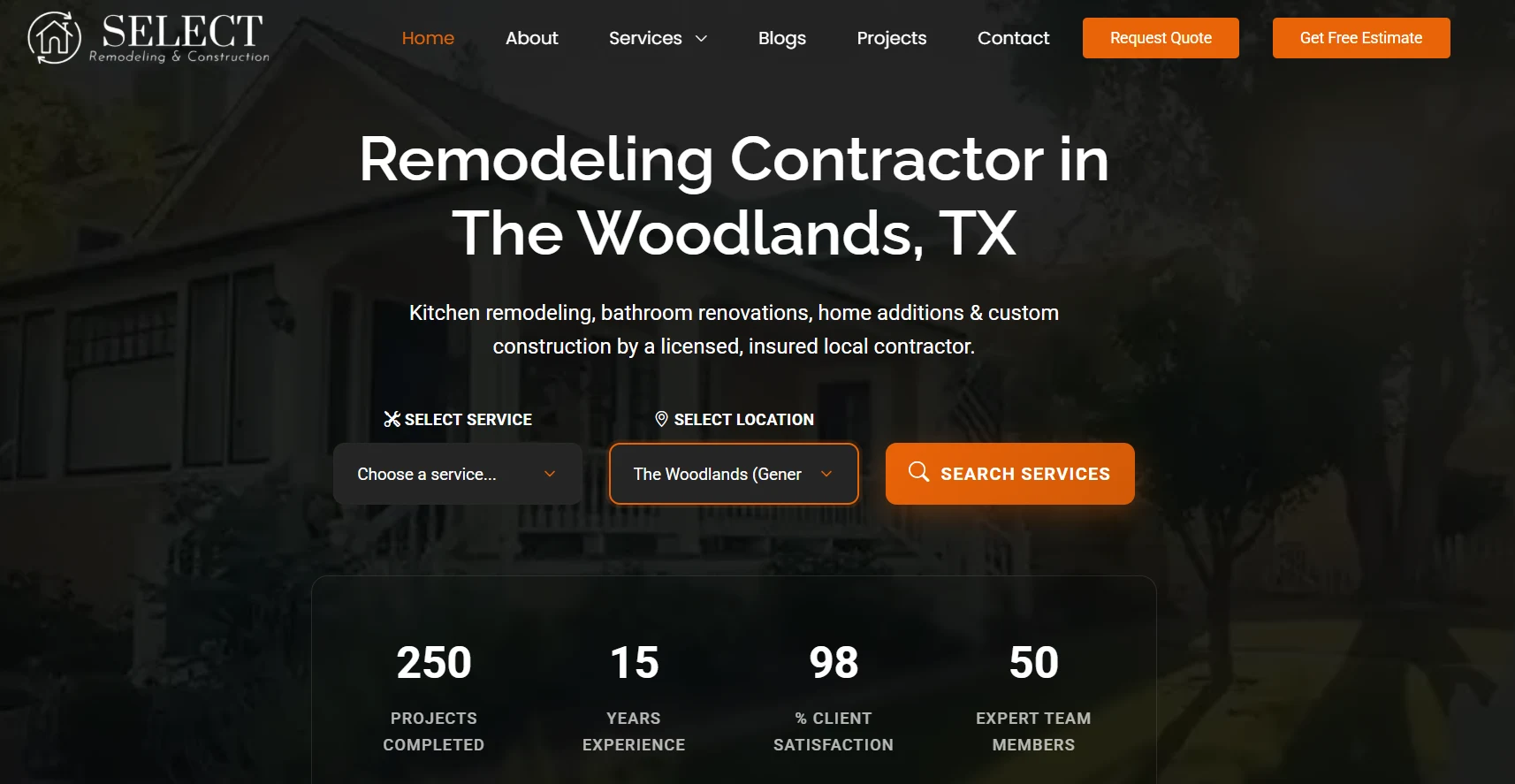
Client website: Select Remodeling & Construction
The Goal
Home remodeling leads are expensive to win and easy to lose. We built an SEO system that does 3 things:
What This SEO System Was Designed To Deliver
| Goal | What It Means In Real Leads |
|---|---|
| Get discovered for service + location intent | Rank across The Woodlands + nearby cities (Conroe, Spring, Tomball, Kingwood, Klein, etc.) for service searches. |
| Load fast & feel smooth on mobile | Use PageSpeed Insights + Core Web Vitals as the benchmark so mobile users don’t bounce before contacting. |
| Convert visitors into estimate requests | Clear CTAs + trust signals so the website doesn’t “leak” leads after users land. |
What Made This SEO Project Challenging (and fun)
Local SEO scale is powerful—but it also creates duplication risk, performance pressure, and crawl complexity if not engineered correctly.
1) Lots of pages = lots of “duplicate risk”
The site has service pages and many location-specific variations (The Woodlands + neighborhoods + nearby cities). This is exactly what you want for local SEO scale—but it increases the risk of similar titles/meta, repeated sections, canonical confusion, and “same page with a different city name” thinness.
2) Performance issues that quietly kill rankings + leads
Google’s performance evaluation is tied to Core Web Vitals (LCP, INP, CLS), measurable in PageSpeed Insights and Search Console. For service businesses, even small improvements can lift form/call completion—especially on mobile.
3) Crawl & internal linking complexity
The site includes many service and blog pages (a good thing), but SEO only works when Google can crawl efficiently, understand the hierarchy, and see clear topical clusters.
Why Screaming Frog mattered
Screaming Frog crawl insights helped prioritize duplicate titles/meta issues and sitewide patterns that can block growth at scale. We used crawl outputs as the “ground truth” before making changes.
Why PageSpeed mattered
Local leads often happen on mobile, under time pressure. Speed + stability improvements reduce friction and make it easier for users to complete estimate requests without lag or layout shifts.
Why internal linking mattered
The more pages you have, the easier it is for important pages to get buried. We improved the internal linking “shape” so service pages and supporting content reinforce each other instead of competing.
Our SEO + Technical Process
How Qaushik Labs worked (audit → fix → verify), without guessing and without fake numbers.
Step 1: Site Crawl & SEO Audit (Screaming Frog)
We used Screaming Frog SEO Spider to crawl the site like Google does and identify technical and on-page issues at scale— the kind of issues that quietly limit growth across service + location pages.
What we audited (high-impact items)
- Duplicate / missing page titles and meta descriptions
- Broken links (4xx), redirect chains, incorrect redirects
- Canonicals + indexability (pages accidentally noindex / wrong canonical)
- H1 duplication, missing headings, thin pages
- Image weight + missing ALT text opportunities
- URL structure consistency across service/location pages
- Internal linking depth (important pages too many clicks away)
How we fixed it (examples)
- Rewrote titles/meta: every page became unique and intent-driven (service + city + benefit).
- Reduced near-duplicate risk: added unique local sections (local FAQs, neighborhood cues, project-style proof) + strengthened canonicals where needed.
- Redirect hygiene: cleaned chains and pointed internal links directly to final URLs.
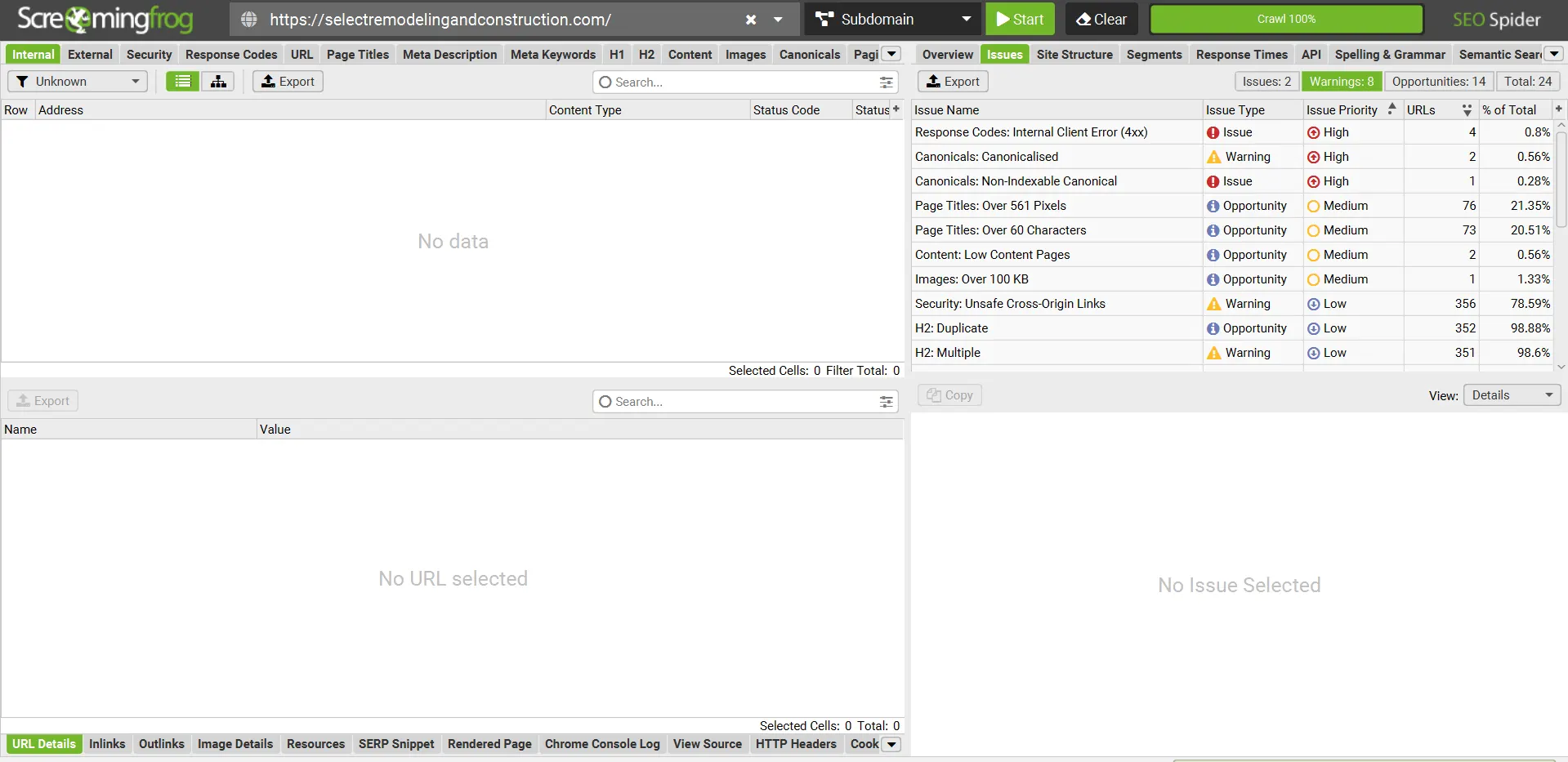
Live reference: Select Remodeling & Construction
Step 2: PageSpeed Insights + Core Web Vitals Fixes
We used PageSpeed Insights to identify what was slowing pages down and mapped fixes directly to Core Web Vitals (LCP, INP, CLS). Then we shipped improvements at the template + asset level, so performance gains apply across many pages (not just one URL).
Common high-impact fixes we implemented
- LCP improvements: optimized hero images (compression + modern formats), reduced render-blocking assets, preloaded critical resources.
- INP improvements: reduced heavy JS, delayed non-critical scripts, improved event responsiveness.
- CLS improvements: reserved space for images/embeds and stabilized late-loading elements that cause layout shifts.
Portfolio-safe statement (no fake numbers):
“We used PageSpeed Insights to identify LCP/INP/CLS bottlenecks, then shipped template-level fixes that improved performance site-wide—especially on mobile—reducing load delay and improving stability across service and location pages.”
(Add real before/after scores using your PSI screenshots.)
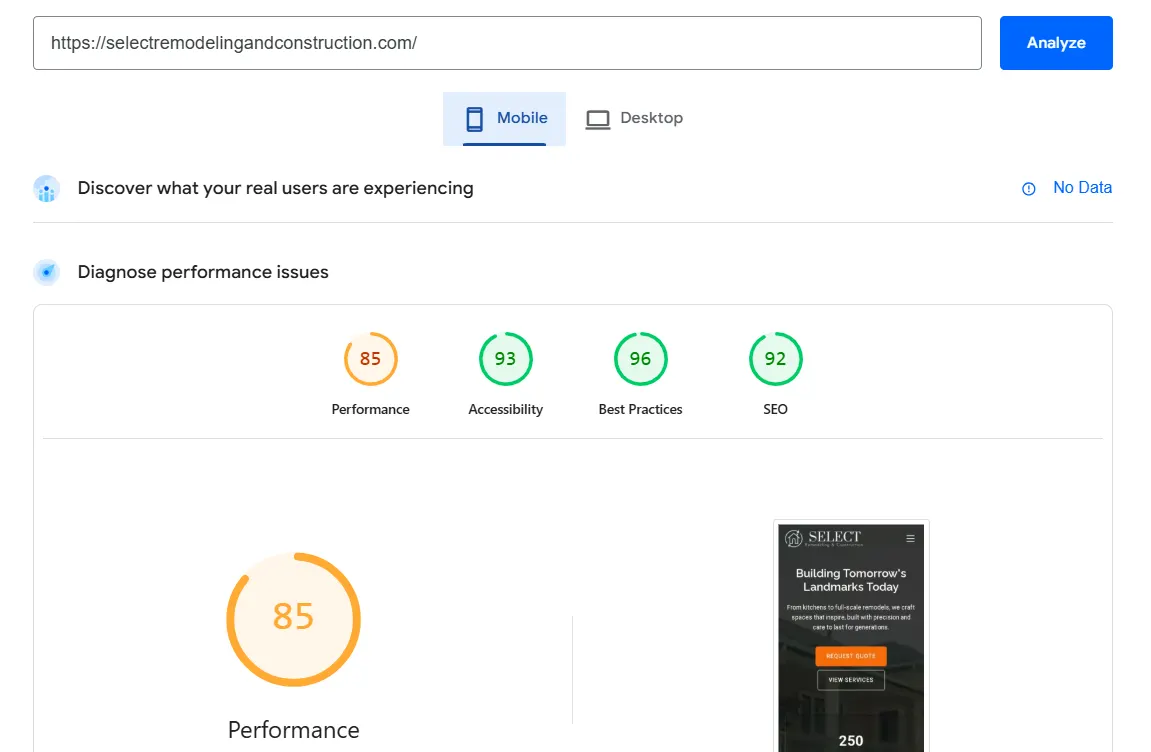
Reference: Interior Remodeling
Step 3: On-Page SEO for Service + Location Pages
The site targets service intent and local intent—like the interior remodeling service page and the local expansion list. We optimized pages to align with what real homeowners search, while staying conversion-focused.
We optimized for
- Primary query intent: “interior remodeling The Woodlands”, “kitchen remodeling The Woodlands”, etc.
- Secondary intent: kitchen, bathroom, flooring, layout redesign, cabinetry, materials and timelines.
- Conversion intent: clear CTAs, trust signals, expectations (process + timelines), and friction removal.
- Internal linking alignment: services and supporting content reinforce each other (instead of competing).
Service page reference: Interior Remodeling (The Woodlands + nearby)
Step 4: Content Strategy (Blog Cluster That Supports Rankings)
The blog section is built to capture “research intent” keywords and guide users into service pages—creating a smart SEO funnel. We supported and optimized the blog structure so content strengthens topical authority for service pages.
What the blog cluster was designed to do
- Target long-tail topics (cost, permits, contractor selection, seasonal remodeling, materials, timelines)
- Strengthen topical authority for core services (kitchen, bathroom, interior remodeling, additions)
- Improve internal linking and time on site (blog → service pages → contact/estimate)
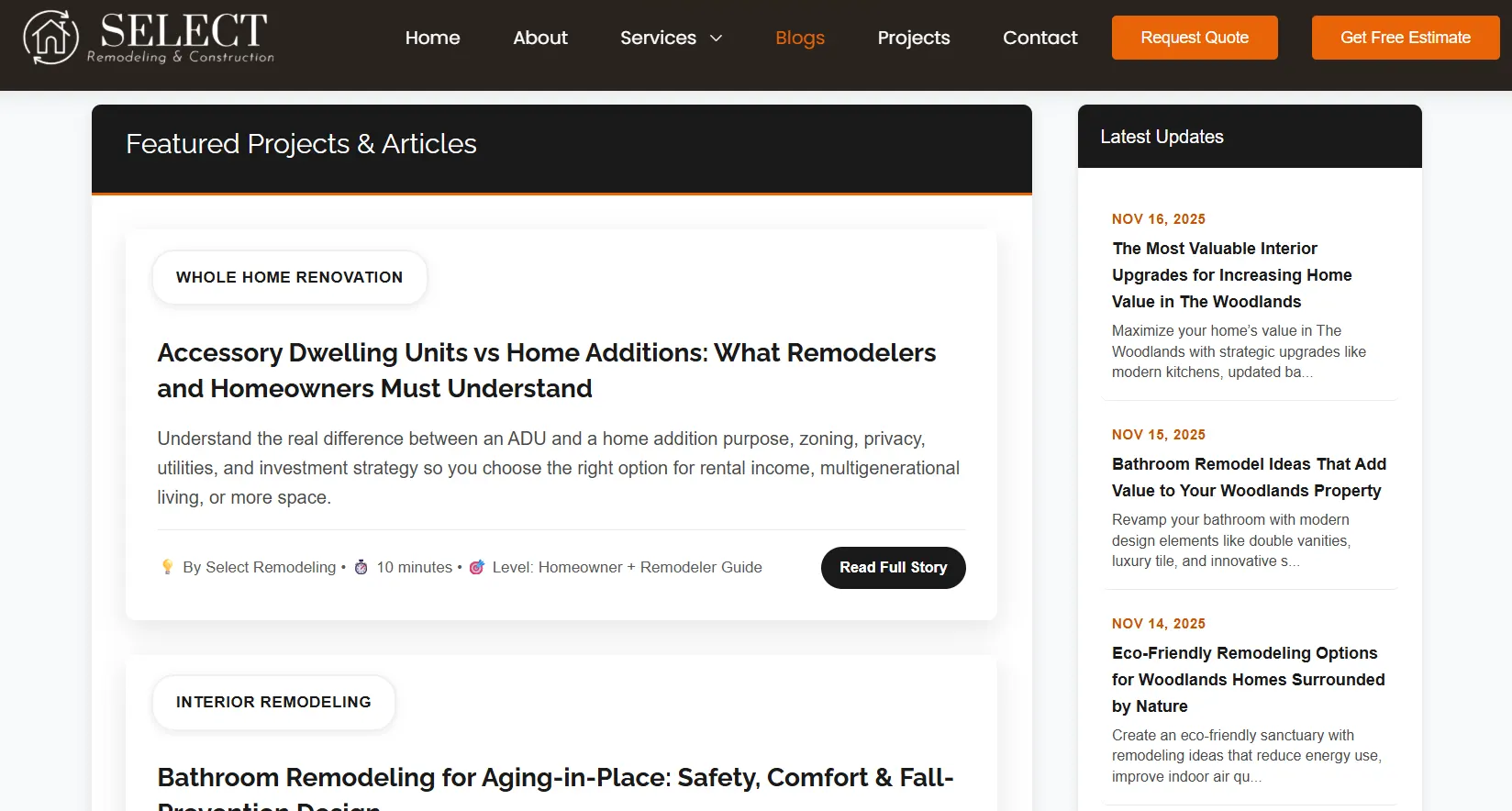
Blog reference: Blogs
The Improvements (What changed after QAUSHIK LABS SEO work)
Truthful, portfolio-ready outcomes—no inflated metrics, no fake numbers.
Outcome Summary
- Crawl Health Improved: fewer duplicates and clearer canonical signals (critical for large location expansions).
- Redirect hygiene improved: reduced wasted crawl from redirect chains and non-ideal internal links.
- Better Page Quality Signals: unique titles + meta descriptions aligned to local/service intent.
- Stronger internal linking: clearer hierarchy across the service structure and supporting pages.
- Faster, smoother pages: PSI-driven fixes mapped to LCP/INP/CLS (speed + stability + responsiveness).
Bottom line: This project shows how SEO works when it’s treated like an engineering + content system—not just “add keywords.” We improved crawl clarity, strengthened service/location relevance, and shipped performance fixes guided by PageSpeed Insights and Core Web Vitals.
Explore the project:
Select Remodeling & Construction
High-intent service page example:
Interior Remodeling
SEO Services :
Build long-term organic visibility with our SEO Services in Woodlands focused on technical excellence, high-intent keyword strategy, and authority-building content. For brands targeting competitive global markets, explore SEO Services in Spring engineered to improve rankings, strengthen domain authority, and drive scalable growth. If your goal is regional dominance, choose SEO Services in Conroe to increase local search visibility and convert organic traffic into qualified business enquiries SEO Construction Service Woodlands .
Frequently Asked Questions
Local SEO + Core Web Vitals questions clients commonly ask.
The goal was to increase local, high-intent visibility for remodeling services (like interior remodeling) while keeping the site fast, crawlable, and conversion-focused. The site already had strong service/location coverage, so the work focused on making the entire system cleaner and more “Google-friendly.”
We primarily used Screaming Frog SEO Spider to crawl the site and identify technical + on-page issues at scale, PageSpeed Insights to find and fix performance problems tied to Core Web Vitals, and Google Search Console’s Core Web Vitals report to validate URL groups.
Screaming Frog helped identify issues that commonly block growth, including duplicate page titles, duplicate meta descriptions, exact duplicate pages that create crawling inefficiencies, and redirect-related hygiene opportunities (redirect planning and cleanup).
We applied a “template + uniqueness” approach: keep a consistent brand format (service + location + benefit), add unique local proof sections (neighborhood cues, project-style angles, local FAQs), and consolidate signals with clean linking and canonical/redirect logic where pages were truly duplicative.
Because performance affects real users and is closely tracked through Core Web Vitals (LCP, INP, CLS). PageSpeed Insights reports these metrics and helps pinpoint what’s slowing pages down—especially for mobile local leads.
We focused on the three Core Web Vitals: LCP (loading speed / largest element load), INP (interaction responsiveness), and CLS (layout stability / shifts).
While fixes vary by site, common improvements include optimizing large hero images and critical resources (LCP), reducing heavy JavaScript and improving responsiveness (INP), and preventing layout shifts by reserving space for images/embeds (CLS).
Both. Technical SEO ensures Google can crawl and understand the site, but content structure wins the query. We optimized service/location pages (example: interior remodeling) and ensured they follow a consistent hierarchy that supports local intent.