

If you've ever typed that question into Google, you're not alone. It's one of the most searched questions by business owners, marketers, and entrepreneurs who've invested in SEO and are wondering is this actually working?
The honest answer? SEO takes time. But the timeline varies and it's largely within your control.
In this guide, we'll break down realistic SEO timelines, the factors that speed things up or slow them down, what you should expect at every stage of your SEO journey, and how to measure progress before the big traffic numbers arrive.
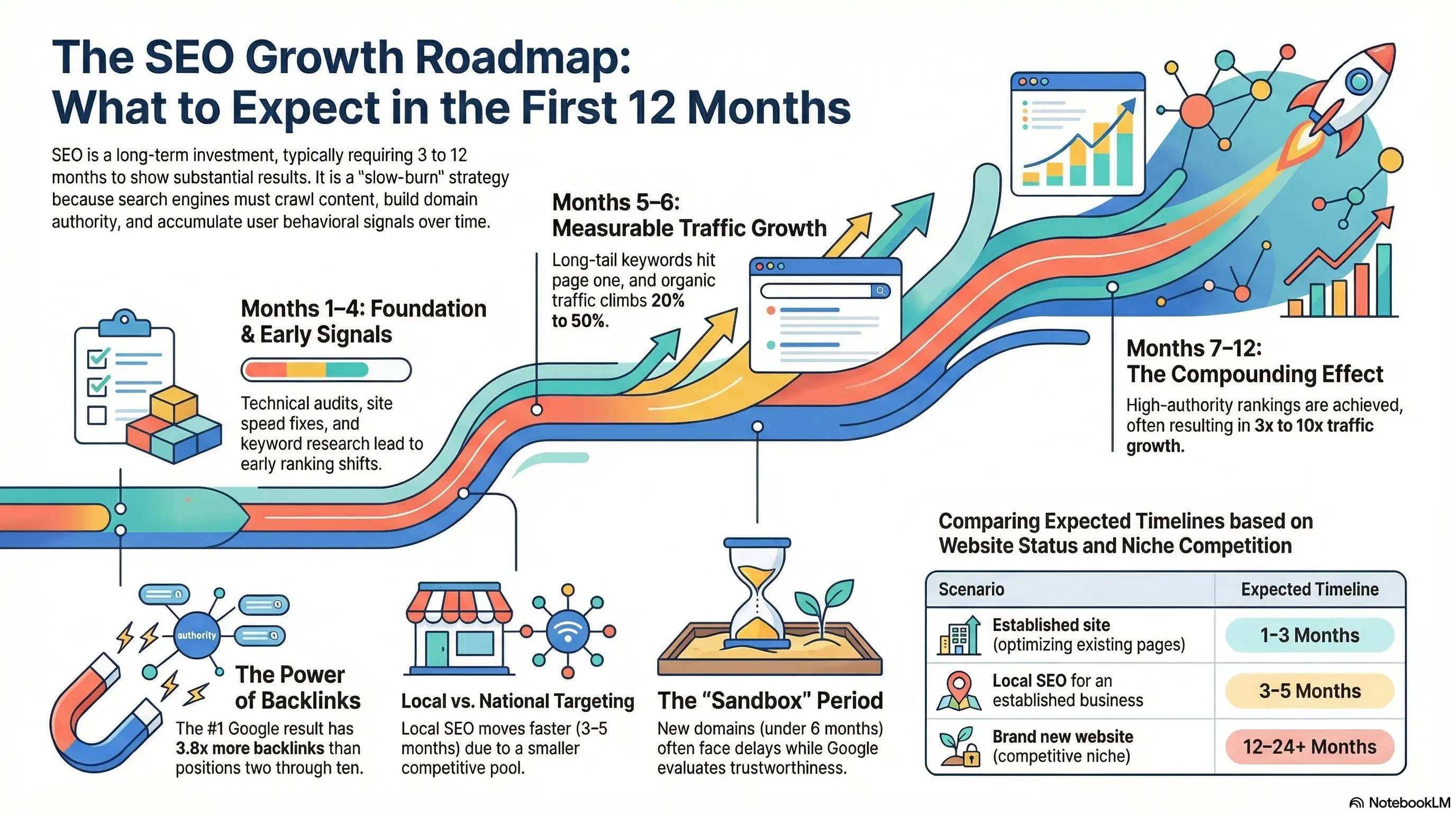
Most SEO professionals agree that it takes anywhere from 3 to 6 months to begin seeing meaningful results, and 6 to 12 months to see substantial traffic and ranking improvements. For highly competitive niches or brand-new websites, it can take 12 to 24 months or more before you're truly competing at scale.
But here's the critical nuance — this isn't a passive clock you set and forget. SEO results depend on dozens of variables unique to your website, your industry, your competition, and the quality of your strategy. A well-executed campaign by an experienced SEO services team will consistently outpace a mediocre one, even with identical timelines.
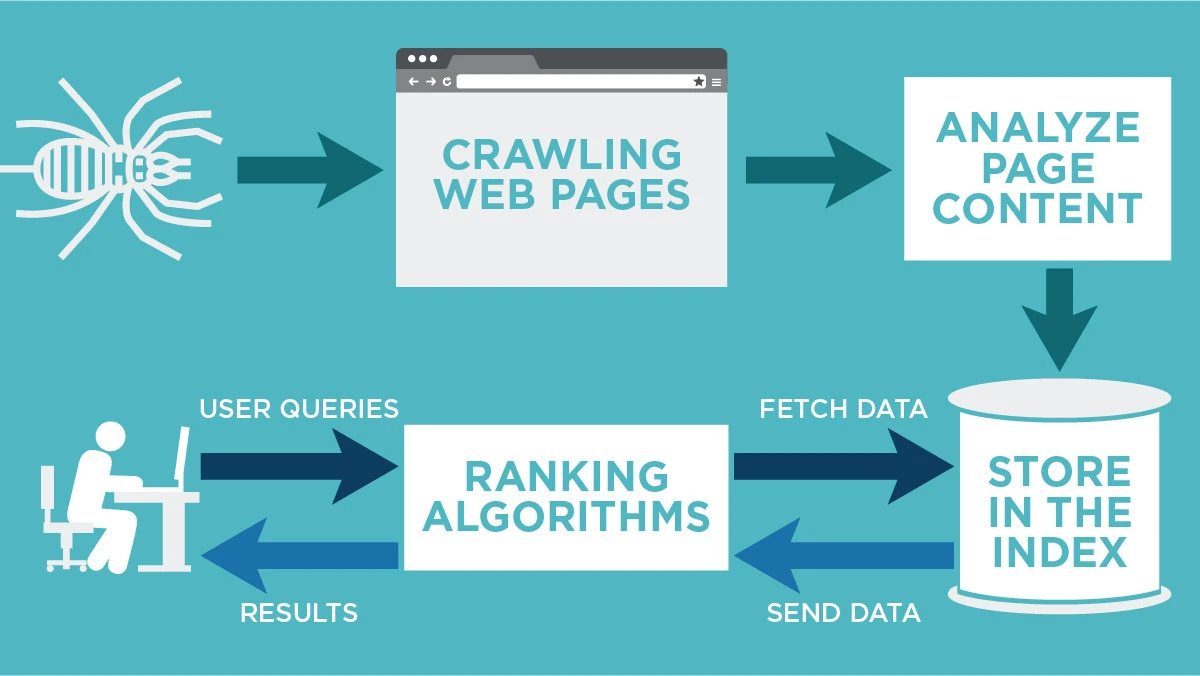
Search engines like Google don't rank pages overnight. The process involves crawling, indexing, evaluating authority, analyzing user behavior signals, and comparing your page against thousands of competitors — all of which require time and accumulated data.
There are three core reasons SEO is a slow-burn strategy:
1. Google's Crawl and Index Cycle
When you publish or update a page, Google needs to discover it, crawl it, and index it before it can rank. Depending on your site's crawl budget, internal linking structure, and overall technical health, this process alone can take anywhere from a few days to several weeks.
2. Domain and Page Authority Builds Gradually
Google's algorithm weighs trust heavily. Older, well-linked domains consistently outrank newer ones in competitive searches. Building high-quality backlinks — one of the strongest ranking signals — is not something that happens overnight. According to Ahrefs, the average top-ranking page is over two years old, which tells you everything about how Google values authority accumulated over time.
3. Content Must Earn Its Ranking Through User Signals
Google doesn't just look at what your page says — it watches how users interact with it. Metrics like click-through rate, time on page, bounce rate, and return visits all factor into how your content is evaluated. This behavioral data takes months to accumulate meaningfully.
Months 1–2: Foundation and Technical Setup
This phase is invisible to most people, but it's where the real work begins. A professional SEO agency will conduct a full technical audit, identify crawlability issues, fix broken links, improve page speed, and ensure mobile responsiveness. Simultaneously, they'll complete deep keyword research, map content to search intent, analyze competitor gaps, and begin on-page optimization.
Google Search Console and Analytics will be properly configured to track baseline data. This foundation determines the ceiling of everything that follows.
Visible results at this stage: Little to none. But every hour invested here pays dividends for years.
Months 3–4: Early Signals and Keyword Movement
By month three, Google has had time to recrawl your optimized pages and begin reassessing their relevance. You'll start noticing early signals:
- Keywords shifting from page 4–5 to page 2–3
- Impressions in Search Console beginning to climb (even without significant clicks yet)
- Improvement in crawl coverage and indexation rates
- Initial traction from backlink outreach efforts
This is often the phase where business owners feel the most anxious. Progress feels slow. But according to Search Engine Journal, the majority of SEO campaigns only begin showing noticeable ranking movement between months 3 and 6 — so what you're experiencing is completely normal and on schedule.
Resist the urge to pivot strategy here. This phase is about staying the course.
Months 5–6: Measurable Traffic Growth Begins
This is where momentum becomes tangible. Long-tail keywords — those specific, lower-competition phrases — start hitting page one. Organic traffic begins climbing noticeably, often 20% to 50% above your month-one baseline. Featured snippet opportunities emerge. And critically, you start seeing conversions from organic traffic, not just visits.
This is also the stage where geographic targeting starts delivering real dividends. Businesses using targeted SEO services in India, for example, often see faster movement in local and regional queries because the competitive landscape is more defined and geo-specific search intent is easier to capture with the right content strategy.
Months 7–12: The Compounding Effect Kicks In
This is where SEO separates itself from every other marketing channel. The content that ranked on page 2 in month 5 climbs to position 3 or 4 by month 8, and often reaches position 1 by month 10 or 11. Backlinks built in month 2 continue passing authority to your pages. New content gets indexed faster because Google now trusts your domain more.
Expect to see:
- Organic traffic 3x to 10x your original baseline
- Multiple keywords ranking on page one simultaneously
- Consistent lead generation or ecommerce sales from organic search
- A measurable reduction in cost-per-acquisition compared to paid channels
Businesses running SEO campaigns in the USA — one of the world's most competitive digital markets — typically hit this compounding phase between months 9 and 12. Similarly, businesses investing in SEO in Scotland find that by the end of the first year, a well-executed regional strategy can dominate local search and drive consistent inbound enquiries.
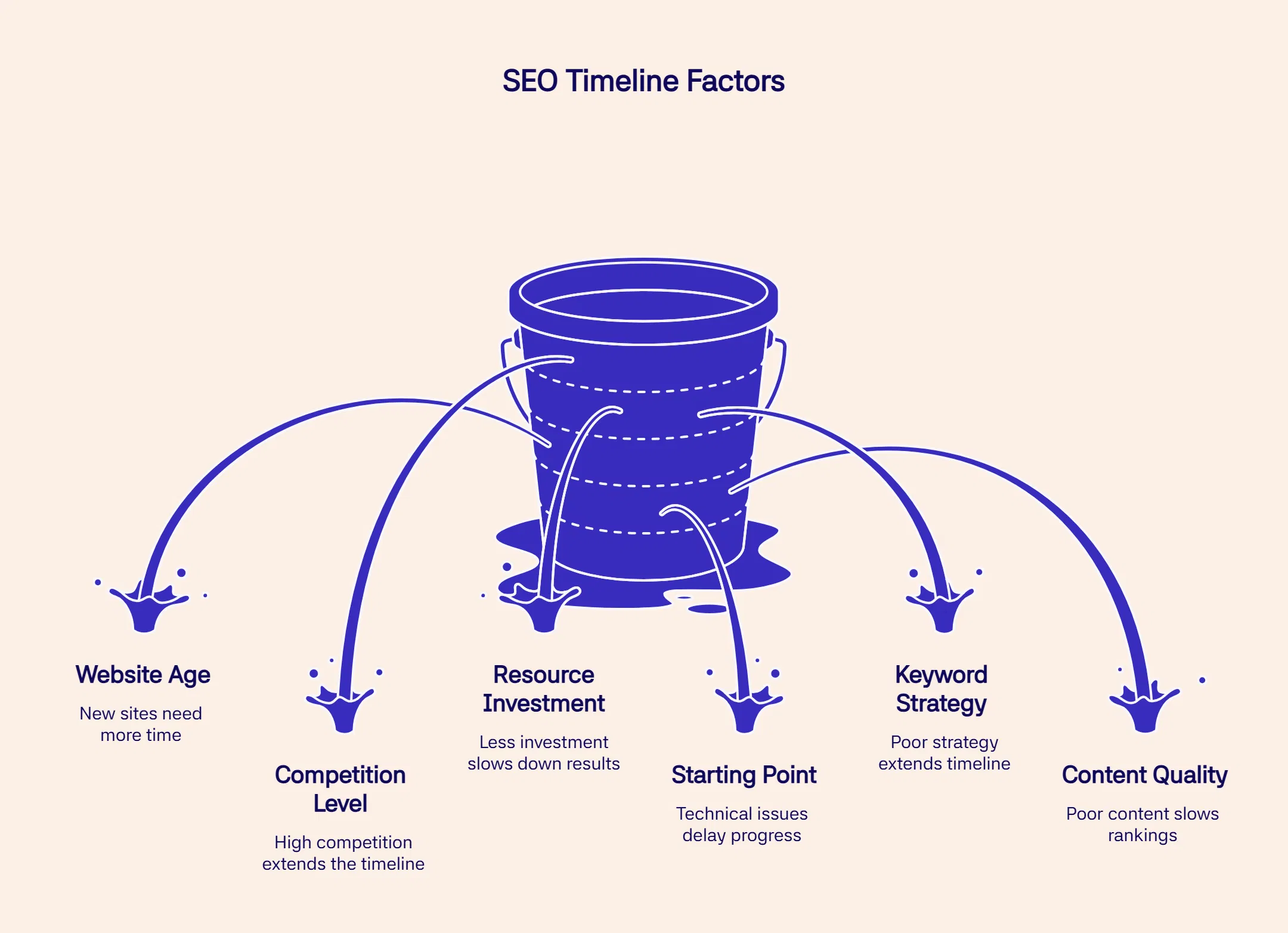
Factors That Speed Up SEO Results
- Website Age and Existing Authority: An established domain with a history of quality content and earned backlinks will rank new pages significantly faster than a brand-new site. Google's trust in older domains is a massive accelerant.
- Niche and Competition Level: Competing for "accountant in Edinburgh" is a very different challenge from competing for "accountant." Niche and long-tail targeting is the fastest path to early rankings and real revenue.
- Technical SEO Health: A fast, mobile-optimized, properly structured website gets crawled more efficiently. Google's Core Web Vitals — measuring page loading, interactivity, and visual stability — are now direct ranking factors. Poor technical health actively suppresses your rankings regardless of content quality.
- Content Quality and Depth: Comprehensive, well-researched content that genuinely answers search intent outranks thin, surface-level pages. Google's Helpful Content System explicitly rewards content written for people, not search engines.
- Consistent Publishing Cadence: Sites that publish high-quality content regularly signal authority and freshness. Each new piece of content is a potential ranking asset working around the clock.
- Strategic Link Building: This is the single biggest accelerant available to you. According to Backlinko, the number one result on Google has on average 3.8 times more backlinks than pages ranked in positions two through ten. Earning links from authoritative, relevant websites compounds your domain authority exponentially.
Factors That Slow Down SEO Results
- New Domain (Under 6 Months Old): New websites often experience a "sandbox" period where Google holds back rankings while it evaluates trustworthiness. This is normal, but it does extend the initial timeline.
- Thin or Low-Quality Content: Pages that don't adequately address search intent, contain duplicate text, or are stuffed with keywords won't rank — and may actively harm your overall site quality score.
- No Link Building Strategy: On-page optimization alone has a ceiling. Without external links passing authority to your domain and pages, you'll struggle to rank for anything beyond the lowest-competition queries.
- Unresolved Technical Issues: Slow load speeds, crawl errors, broken internal links, missing sitemaps, or poor mobile experience can all suppress rankings even when your content is excellent.
- Inconsistent Effort: SEO is not a campaign with a start and end date — it's an ongoing investment. Stopping and starting resets momentum and allows competitors to regain ground.
| Scenario | Expected Timeline for Meaningful Results |
|---|---|
| Brand new website, highly competitive niche | 12–24+ months |
| Brand new website, low-competition niche | 6–12 months |
| Established site, optimizing existing pages | 1–3 months |
| Established site, publishing new content | 3–6 months |
| Local SEO for an established business | 3–5 months |
| E-commerce SEO | 6–18 months |
| National SEO campaign | 9–18 months |
Significantly, yes.
Local SEO — ranking for searches like "web designer near me" or "SEO agency in Glasgow" — moves considerably faster than national campaigns because you're competing with a smaller pool of local businesses rather than thousands of national competitors. Most local SEO campaigns begin showing results within 3 to 5 months and can produce strong leads well before the 6-month mark.
National and international SEO campaigns face far greater competition and require longer investment windows. However, the reward scales accordingly — national organic visibility generates far greater volume and brand authority than any local campaign can match.
The smartest approach for most businesses is to begin with local or regional SEO to generate early revenue and build domain authority, then use that foundation to scale nationally. This is exactly the kind of phased strategy that experienced SEO professionals design for clients across different markets and growth stages.
One of the most frustrating aspects of SEO is that the most meaningful metric — revenue from organic traffic — is one of the last to appear. But there are clear leading indicators that tell you whether your campaign is on track:
- Impressions in Google Search Console: Impressions show how often your pages appear in search results — even when users don't click. Rising impressions mean Google is beginning to surface your content for relevant queries. This is one of the earliest positive signals.
- Crawl Coverage and Indexation: Is Google discovering and indexing your pages at the expected rate? Gaps here often indicate technical issues worth addressing immediately.
- Keyword Ranking Movement: Track your target keywords weekly. Moving from position 45 to position 18 in 60 days may not generate traffic yet, but it's a strong signal that your content is gaining traction. Tools like Semrush or Ahrefs make this straightforward to monitor.
- Organic Click-Through Rate: If impressions are climbing but clicks are flat, your title tags and meta descriptions may need improvement. CTR optimization is often a quick win that accelerates results.
- Backlink Profile Growth: Are you earning new backlinks consistently? Tracking this helps you understand whether your link-building efforts are working and whether your domain authority is growing.
- Page Speed and Core Web Vitals: Improving your technical performance scores — even before rankings move — means you're removing barriers that have been holding you back.
Patience is required, but passivity isn't. Here's how to maximize momentum during the waiting period:
- Run Paid Ads in Parallel: Google Ads and Meta Ads generate immediate traffic while your organic rankings build. Think of it as renting traffic while you construct a long-term asset.
- Capture Every Visitor With Email: Build an email list from the organic traffic you do receive. Email marketing delivers reliable ROI independently of algorithm fluctuations.
- Double Down on Long-Tail Keywords: These lower-competition, higher-intent phrases rank faster and convert better. Ranking for them first creates the authority foundation needed to compete for broader terms later.
- Publish Consistently: Use this window to build a substantial content library. Every article, guide, or landing page you publish is a potential long-term traffic asset.
- Strengthen Your Brand's Digital Presence: Online reviews, business directory listings, social signals, and brand mentions all support SEO indirectly. A stronger brand presence accelerates trust signals across the board.
Here is the most uncomfortable truth about SEO timelines: every month you delay starting is a month added to your wait for results.
The businesses appearing on page one of Google today started their SEO journey 12, 18, or 24 months ago. The authority they've accumulated, the backlinks they've earned, and the content they've published form a compounding moat that grows harder to overcome with each passing month.
The best time to invest in SEO was a year ago. The second-best time is today.
SEO is not a shortcut — and anyone promising you first-page rankings in 30 days is either selling you black-hat tactics that will eventually penalize your site or simply misleading you. What SEO genuinely offers is something no other digital channel can replicate: sustainable, compounding, long-term organic growth that doesn't evaporate the moment your budget runs out.
Understand your realistic timeline. Invest in quality — content, technical health, and link building. Track the right leading indicators. And above all, work with a team that is transparent about what's being done, why, and what to expect.
Whether you're building visibility for a business in Asia, expanding into North American markets with US-focused SEO, growing regionally with SEO in Scotland, or scaling across South Asia with SEO services tailored for India — the principles are universal. Start early. Stay consistent. Trust the process.
The timeline may feel long. But for businesses that commit, SEO becomes the most valuable and cost-efficient growth channel they've ever invested in.
Ready to Transform Your Digital Presence?
Let Qaushik Labs help you implement growth-focused solutions for your business. From websites and SEO to ads and automation, we’re here to help you generate better leads and revenue.
Get Started TodayMost SEO campaigns begin showing meaningful results between 3 and 6 months. Substantial traffic and ranking improvements typically appear between 6 and 12 months. Brand-new websites in highly competitive niches may take 12 to 24 months to compete at scale.
SEO requires time because Google must crawl and index your pages, evaluate domain authority built through backlinks, and collect behavioral data (click-through rate, time on page) from real users. All three processes accumulate gradually and cannot be artificially rushed.
Key accelerants include an older, authoritative domain; a low-competition or niche focus; excellent technical SEO health (fast load times, mobile optimization, Core Web Vitals); consistent high-quality content publishing; and a strategic link-building campaign.
Yes. Local SEO campaigns — targeting city or region-specific searches — typically produce results within 3 to 5 months because you're competing against a smaller pool of local businesses. National campaigns face greater competition and generally require 9 to 18 months for strong results.
Track leading indicators: impressions in Google Search Console, crawl coverage and indexation rates, weekly keyword ranking movement, organic click-through rate, backlink profile growth, and Core Web Vitals scores. These metrics show forward momentum before traffic numbers fully reflect it.